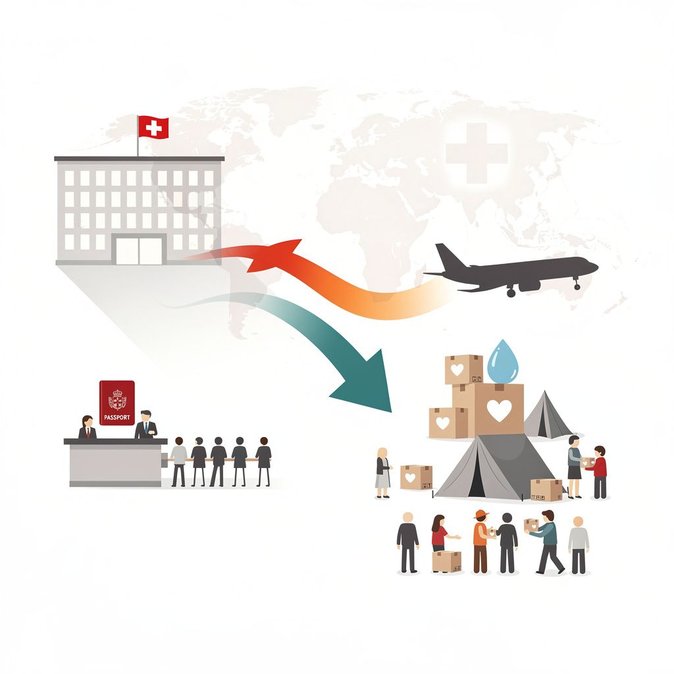
The Swiss Federal Council devoted much of its 24 June 2026 weekly meeting to the future shape of the country’s International Cooperation Strategy 2029-32. Ministers agreed that, while the overall envelope for development assistance will remain broadly unchanged at around CHF 2.4 billion per year, the money – and the people who manage it – will be redeployed more selectively. Responsibility in each partner country will follow a new “one country, one department” rule: the Swiss Agency for Development and Cooperation (SDC) will concentrate on low-income states that face acute poverty, health or forced-migration pressures, while the State Secretariat for Economic Affairs (SECO) will handle middle-income markets where trade and investment are the priority. Latin-American programmes will be scaled back, and SECO will assume lead responsibility for cooperation with the EU, the Western Balkans and parts of Asia. To free up funds for frontline humanitarian action, the Council approved savings of about CHF 113 million between 2027 and 2030. Roughly 100 jobs will disappear – two-thirds among locally hired staff at Swiss embassies and one-third within the federal administration in Bern. Federal employees will be redeployed where possible, but the communiqué concedes that some local staff overseas will be made redundant. Corporate travel managers should note that local staff in Swiss visa sections often handle first-level checks and appointment scheduling; head-count reductions could translate into longer processing times in certain posts, especially in Latin America where missions are already lightly staffed. Humanitarian assistance emerges as the clear winner. Its share of the cooperation budget will rise from 26 % today to about 40 % in the next cycle, reflecting the global uptick in conflict-driven displacement. The Council justified the shift by pointing out that between 2020 and 2025 it had to request 13 supplementary humanitarian credits from Parliament – more than double the number in the preceding 14 years. Switzerland’s aid agency will be mandated to respond first to acute crises, then pivot to risk-mitigation and resilience measures where conflicts prove protracted. The new approach implicitly recognises that humanitarian operations often require rapid staff deployments, specialised visas and exemptions from standard Schengen rules. Business-mobility stakeholders should watch two practical implications. First, tighter geographic focus means companies running projects in countries where cooperation is winding down (notably parts of Latin America) may find reduced embassy bandwidth for economic-promotion events and for handling work-permit endorsements. Second, the internal redeployment of federal staff could slow decision-making on mobility-related dossiers – such as third-country quota allocations or Schengen code amendments – during the hand-over period. The Federal Department of Foreign Affairs (FDFA) and the Economic Affairs Department (EAER) must draft a public consultation paper on the new strategy by spring 2028, giving businesses an opportunity to flag administrative pain points before the reforms take effect.
Source: The Federal Council