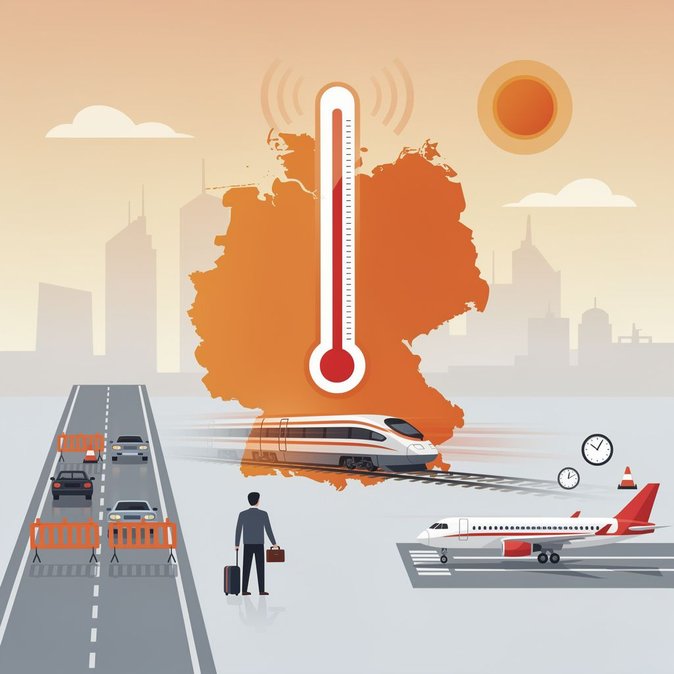
Germany endured its hottest June day on record on Saturday, 27 June 2026, when the Deutscher Wetterdienst measured 41.5 °C in Möckern-Drewitz, Saxony-Anhalt. The extreme temperatures rippled through every mode of transport. On the motorway network, “blow-ups” caused by expanding asphalt forced lengthy closures on the A2, A1, A7 and several stretches of the A10 Berlin ring road; emergency crews sprayed carriageways with water to keep surfaces cool. Deutsche Bahn restricted speed on large parts of the long-distance network and advised passengers to postpone non-essential trips; air-conditioning failures led to several ICE terminations en route. The aviation sector also struggled.
Travellers forced to rebook or extend stays because of the heatwave can streamline any visa, passport or residence-permit adjustments through VisaHQ’s Germany portal (https://www.visahq.com/germany/). The service fast-tracks Schengen paperwork, offers real-time status alerts and provides expert guidance on entry rules, giving you one less thing to worry about while rail, road and flight timetables remain in flux.
By late afternoon on 27 June, Frankfurt and Munich airports had logged more than 180 heat-related departure delays as ground handlers rotated staff more frequently and limited engine-run-up times on the apron. Lufthansa activated its “hot-weather waiver”, allowing free re-bookings within seven days. Smaller regional airports such as Bremen and Nürnberg reported runway-surface temperatures of over 55 °C, edging close to the limits for safe operations of some regional jet tyres. Municipal authorities in Berlin, Hamburg and Cologne cancelled open-air festivals and advised residents to avoid unnecessary travel. Delivery fleets and ride-hailing platforms imposed surge-pricing moratoria to reduce the number of vehicles on overheated streets. The Federal Ministry for Digital and Transport (BMDV) reiterated that Germany’s 2024 Heat-Resilient Infrastructure Plan—funding thicker asphalt and shade structures at key rail junctions—will be accelerated, with €750 million of the €2 billion package brought forward to 2026. For business travellers the practical implications are immediate: expect rolling motorway closures, slower long-distance trains and knock-on delays at hub airports for at least another week while repairs continue. Companies with duty-of-care programmes should monitor the DWD’s red warnings, encourage flexible working and remind drivers to carry water and fuel, as service-station supplies are already strained in parts of Bavaria and Saxony.
Travellers forced to rebook or extend stays because of the heatwave can streamline any visa, passport or residence-permit adjustments through VisaHQ’s Germany portal (https://www.visahq.com/germany/). The service fast-tracks Schengen paperwork, offers real-time status alerts and provides expert guidance on entry rules, giving you one less thing to worry about while rail, road and flight timetables remain in flux.
By late afternoon on 27 June, Frankfurt and Munich airports had logged more than 180 heat-related departure delays as ground handlers rotated staff more frequently and limited engine-run-up times on the apron. Lufthansa activated its “hot-weather waiver”, allowing free re-bookings within seven days. Smaller regional airports such as Bremen and Nürnberg reported runway-surface temperatures of over 55 °C, edging close to the limits for safe operations of some regional jet tyres. Municipal authorities in Berlin, Hamburg and Cologne cancelled open-air festivals and advised residents to avoid unnecessary travel. Delivery fleets and ride-hailing platforms imposed surge-pricing moratoria to reduce the number of vehicles on overheated streets. The Federal Ministry for Digital and Transport (BMDV) reiterated that Germany’s 2024 Heat-Resilient Infrastructure Plan—funding thicker asphalt and shade structures at key rail junctions—will be accelerated, with €750 million of the €2 billion package brought forward to 2026. For business travellers the practical implications are immediate: expect rolling motorway closures, slower long-distance trains and knock-on delays at hub airports for at least another week while repairs continue. Companies with duty-of-care programmes should monitor the DWD’s red warnings, encourage flexible working and remind drivers to carry water and fuel, as service-station supplies are already strained in parts of Bavaria and Saxony.