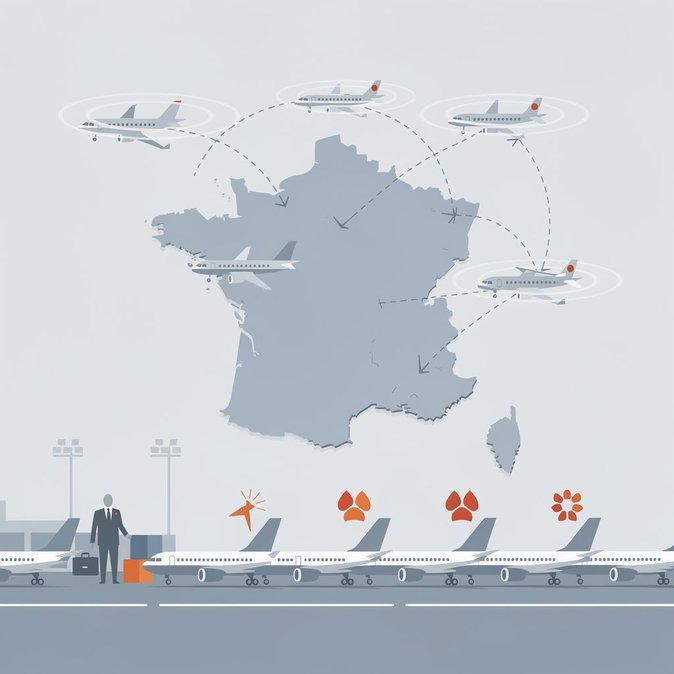
French air-traffic controllers belonging to the majority SNCTA union have formally filed notice of a four-day nation-wide walk-out from Thursday 2 July to Sunday 5 July. The industrial action – announced in the early hours of Sunday, 28 June – comes after wage talks with the Direction Générale de l’Aviation Civile (DGAC) stalled over weekend and follows a record-breaking 11-day heatwave that has already stretched airport operations. According to figures released by the DGAC, up to 40 % of slots at Paris-Charles-de-Gaulle, Paris-Orly, Lyon, Marseille, Nice and Toulouse will have to be pre-emptively cancelled each day, equivalent to roughly 1,800 movements over the four-day period. Ryanair, easyJet, Air France–KLM and the IAG group are expected to be the hardest hit because they rely heavily on French upper-airspace corridors for both domestic and over-flight traffic between the UK, Spain, Italy and Greece. Business-travel managers are bracing for a repeat of the chaos seen during the 2024 strike wave, when airlines racked up an estimated €300 million in re-routing costs. Global distribution systems (GDS) indicate that routings which avoid French FIRs – notably over the Bay of Biscay and via German airspace – are already 95 % full for the period. Eurocontrol’s Network Manager has asked carriers to file alternative flight plans no later than 12 hours before departure to ease pressure on the tactical flow-management system. Companies with time-critical shipments should note that express-freight carriers such as FedEx (hub at CDG) and DHL (hub at Leipzig, reliant on French over-flights) have warned of potential 24- to 48-hour delivery slippages. Mobility teams are being advised to activate remote-work contingencies and to encourage travellers to switch to rail, particularly the Paris–Lyon–Marseille high-speed corridor, where extra TGV seats will be released. Travellers whose flights are cancelled retain EU261 compensation rights, but airlines have 14 days to offer either re-routing or a full refund. Longer term, the confrontation again highlights the vulnerability of pan-European mobility to national labour disputes. The European Commission’s long-delayed proposal to create a minimum air-traffic-management service level during strikes is still blocked in Council, largely due to opposition from France and Italy. Unless a compromise is reached, corporate travel buyers may need to continue building additional buffer days into itineraries that depend on French airspace.
Source: AK&M Newswire