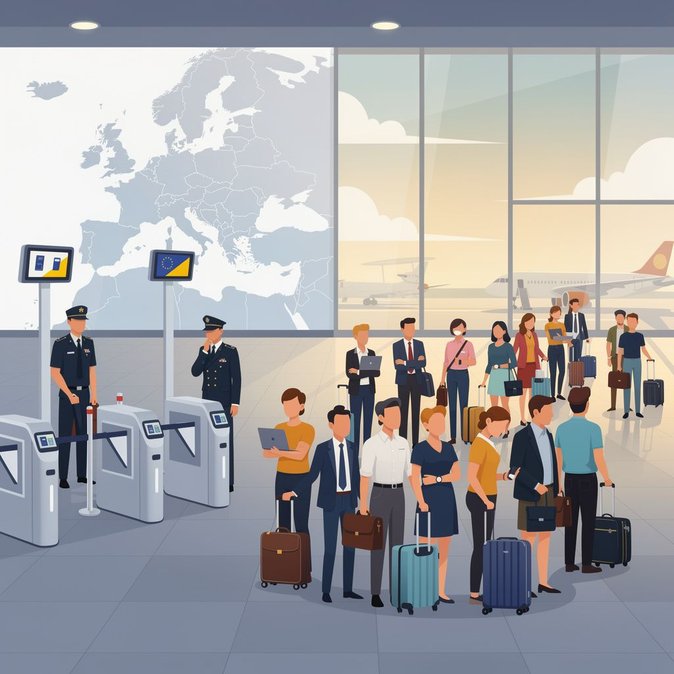
Belgian holiday-makers setting off from Brussels Airport this week have been warned that the European Union’s new Entry/Exit System (EES) is proving so disruptive that the aviation industry is asking Brussels for the right to switch it off during peak summer traffic. In an open letter dated 1 July 2026, ACI Europe, Airlines for Europe (A4E) and the International Air Transport Association (IATA) told Commission President Ursula von der Leyen that the scheme has reached a “critical point”. Border-control bottlenecks of up to five hours are being recorded at a number of Schengen airports, including Brussels, because every non-EU traveller must now provide fingerprints and a facial image before entering or leaving. The EES, which became fully operational in April, was designed to replace manual passport-stamping and tighten enforcement of the 90/180-day rule. Instead, airlines say, the extra processing time is causing missed connections, delayed departures and terminal overcrowding. The three organisations want member states to be given legal leeway to suspend biometric capture whenever passenger throughput exceeds the capacity of border booths, at least for the rest of July and August. They are also seeking a permanent “operational flexibility mechanism” by September so that EES can be paused in clearly-defined exceptional circumstances, similar to the orange-level snow plans used in air-traffic control. For Belgian companies that rely on frequent travel – from life-sciences firms in Wallonia to tech start-ups around Leuven – the stakes are high. Protracted queues increase the risk of employees missing onward flights, compromise just-in-time supply chains and inflate duty-of-care costs. Travel-management companies are already advising clients to schedule longer connection windows at Brussels, Charleroi and other Schengen hubs. If the Commission refuses to budge, experts predict a surge in premium-lane purchases and a possible modal shift to rail for meetings in neighbouring countries, undermining Brussels Airport’s competitive position as a business-travel gateway. Conversely, a temporary suspension could relieve immediate pressure but leave border police scrambling to maintain security standards without the biometric database they have spent years building. Either way, multinationals with operations in Belgium should brief travellers on potential delays, monitor real-time queue data provided by the airport app BRUce, and review travel-insurance cover for missed connections. They should also keep an eye on Commission communications in the coming days; a swift decision is expected before the main July holiday peak.
Source: Euronews