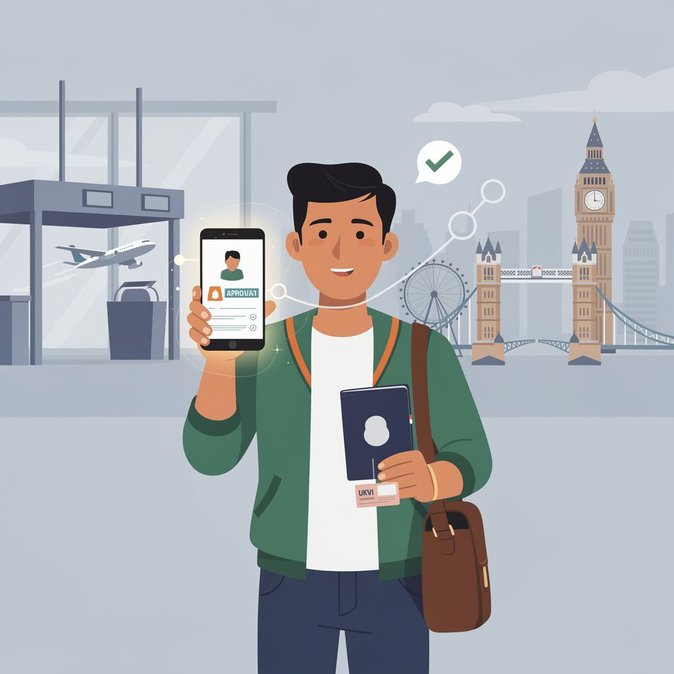
Indian travellers heading to the United Kingdom will no longer receive a visa vignette affixed to their passport. In guidance updated on 1 July 2026, UK Visas & Immigration confirmed that all successful applications made outside the UK now result in a purely digital ‘eVisa’. Applicants still lodge biometrics at a visa application centre (VAC), but once approved they must create or sign into a UKVI online account to view and download proof of their immigration status.
VisaHQ’s India team can smooth the transition to eVisas by guiding travellers through the online account set-up, scheduling biometrics at the nearest VAC and double-checking that the digital permission letter meets airline requirements. Its platform (https://www.visahq.com/india/) also lets corporate mobility managers track multiple applications in real time and receive automatic reminders when an employee’s status is about to expire.
The change is part of London’s multi-year project to digitise the border and aligns the UK with Australia and New Zealand, which have long relied on electronic travel authorisations. UKVI says eVisas cannot be lost, stolen or altered and will speed up airline check-in and automated-gate clearance. Physical passports will be returned sooner because staff no longer have to print and stick vignettes. For Indian corporates, the shift means tighter internal processes: travellers must print or store a digital ‘permission to travel’ letter, airlines must validate eVisas via the Advance Passenger Information System, and mobility teams must update policy handbooks that reference visa labels. Companies sponsoring Tier 2 and Global Business Mobility routes should ask employees to share a ‘prove your status’ link instead of photocopying a vignette page. Indian service providers report a spike in queries from travellers unfamiliar with digital accounts and worried about airport Wi-Fi. Experts advise downloading a PDF copy of the eVisa or taking screenshots before departure. Those with existing vignette stickers may continue to use them until they expire; renewals will convert to eVisas automatically.
VisaHQ’s India team can smooth the transition to eVisas by guiding travellers through the online account set-up, scheduling biometrics at the nearest VAC and double-checking that the digital permission letter meets airline requirements. Its platform (https://www.visahq.com/india/) also lets corporate mobility managers track multiple applications in real time and receive automatic reminders when an employee’s status is about to expire.
The change is part of London’s multi-year project to digitise the border and aligns the UK with Australia and New Zealand, which have long relied on electronic travel authorisations. UKVI says eVisas cannot be lost, stolen or altered and will speed up airline check-in and automated-gate clearance. Physical passports will be returned sooner because staff no longer have to print and stick vignettes. For Indian corporates, the shift means tighter internal processes: travellers must print or store a digital ‘permission to travel’ letter, airlines must validate eVisas via the Advance Passenger Information System, and mobility teams must update policy handbooks that reference visa labels. Companies sponsoring Tier 2 and Global Business Mobility routes should ask employees to share a ‘prove your status’ link instead of photocopying a vignette page. Indian service providers report a spike in queries from travellers unfamiliar with digital accounts and worried about airport Wi-Fi. Experts advise downloading a PDF copy of the eVisa or taking screenshots before departure. Those with existing vignette stickers may continue to use them until they expire; renewals will convert to eVisas automatically.