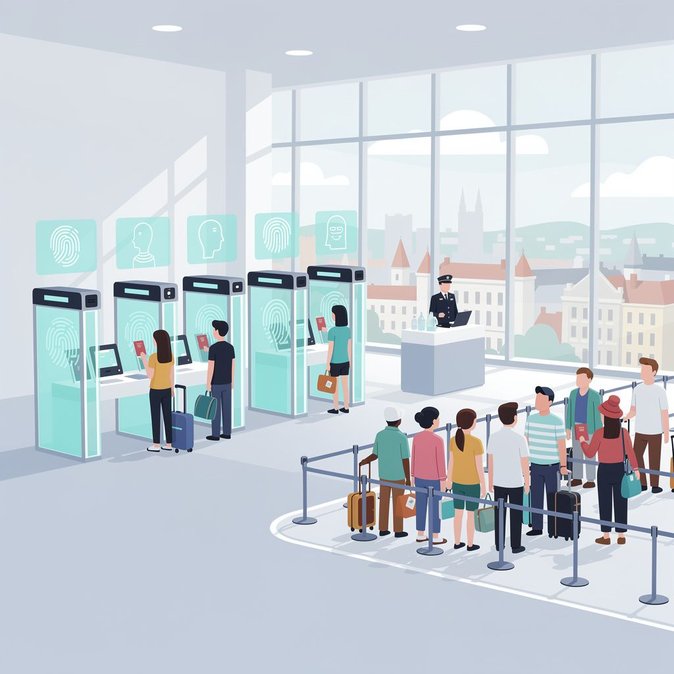
Travellers arriving in and departing from Kraków–Balice on Saturday morning, 4 July, faced waits of up to 90 minutes at passport control, after a surge in non-EU holidaymakers collided with the first full weekend of the EU’s new Entry/Exit System (EES). Low-cost giant Ryanair and the management team at Berlin-Brandenburg Airport sounded the alarm earlier in the week, warning that the biometric registration process—facial image, four-fingerprints and passport swipe on both entry and exit—was slowing passenger throughput at Europe’s leisure gateways. Today GNcrypto, a Polish tech-news outlet, reported similar congestion in Kraków, one of southern Poland’s main corporate-travel airports. Under EES, which has been fully operational at Polish land, sea and air borders since 10 April 2026, every third-country national entering the Schengen Area for a short stay must complete a biometric enrolment the first time they cross an external border after that date; repeat travellers have their data matched on subsequent trips. While the system eliminates passport stamping and enhances over-stay detection, it can add 30–60 seconds per first-time passenger—enough to create bottlenecks when several wide-body charters arrive back-to-back. Kraków Airport told corporate-travel managers that it has doubled the number of staffed booths during the morning-peak “wave” (06:00–09:00) and is accelerating the rollout of self-service kiosks. Carriers are urging non-EU passengers—including post-Brexit UK citizens and US leisure travellers—to arrive at least three hours before departure until throughput stabilises. Business-travel programmes should update pre-trip information to include EES timing, advise employees to carry printed confirmations of onward hotel or meeting bookings (often requested by border officers after biometric capture) and consider Fast-Track services where available. Mobility teams relocating third-country staff to Poland should also track how enrolment data in EES will link automatically to future ETIAS travel-authorisation applications once that system goes live in 2027.
Source: GNcrypto