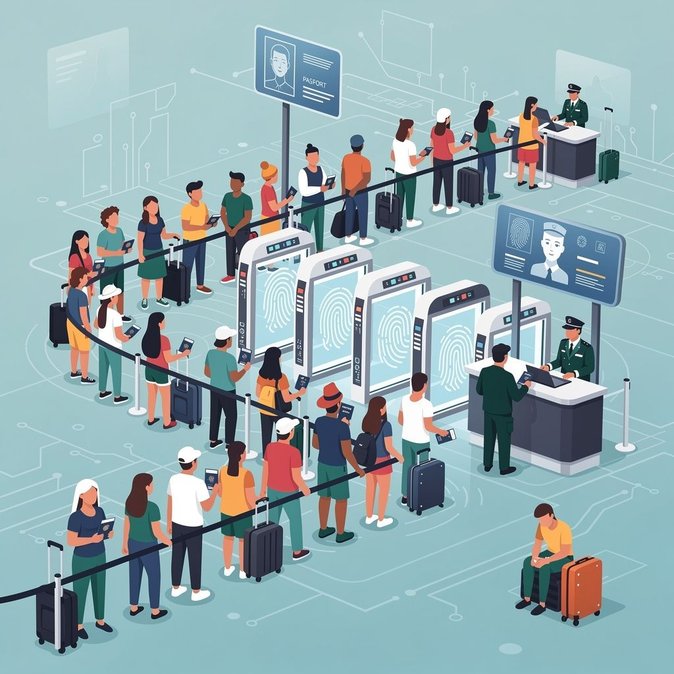
Responding to mounting pressure from airlines and airports, European Commission president Ursula von der Leyen acknowledged on 5 July that “technical problems” are hampering the new Entry/Exit System (EES) and said Brussels is working with member states to smooth the roll-out. Several Spanish airports and land crossings reported waits of two to five hours during the first weekend of the summer season as non-EU travellers struggled with fingerprint kiosks. The EES, fully operational since April, replaces passport stamps with biometric enrolment and automated exit records. Airlines for Europe, ACI Europe and IATA have all urged the Commission to allow temporary suspension during July–August peaks; current EU rules only permit six-hour pauses in extreme congestion. Von der Leyen’s remarks came after Irish interior minister Jim O’Callaghan revealed that 110 million passengers have already been processed and that more than 1,000 security-risk alerts were generated—a statistic Brussels cites as proof of the system’s value. Yet carriers argue the technology is not traveller-ready: easyJet and Ryanair both warn of missed flights, while Spanish tourism boards fear reputational damage just as UK visitor numbers recover. For corporate mobility teams, the headline is clear: factor in at least 45 extra minutes for first-time Schengen entrants transiting Spain and brief travellers on biometric capture (all four fingerprints plus facial scan). Companies running shuttle operations between Gibraltar and Andalucía should note that Spanish police at the border now carry handheld EES tablets; group movements may need staggered departures to avoid tailbacks. EU officials will meet industry leaders next week to discuss software patches, additional staffing and a potential pre-registration app—measures that could ease pressure before August’s peak but are unlikely to deliver an immediate cure.
Source: KoSSev