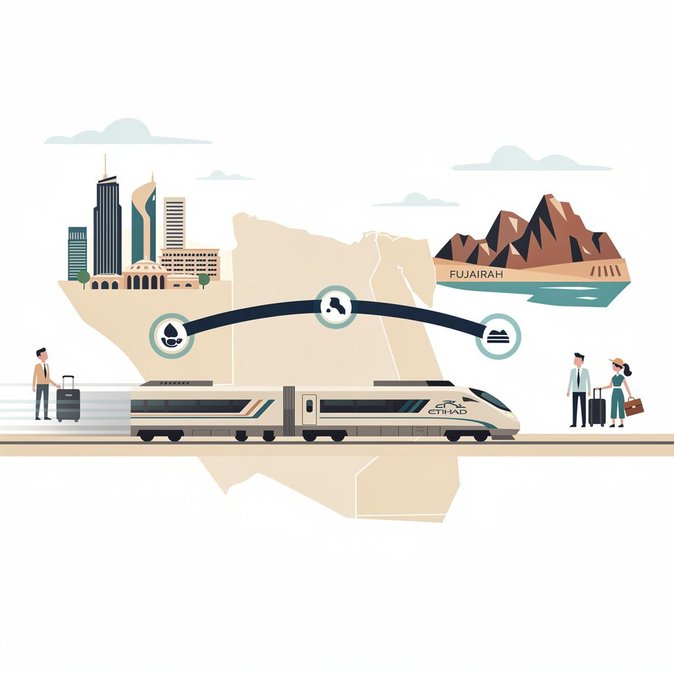
The UAE has entered the age of inter-city rail travel. On 5 July 2026, Etihad Rail ran its first public passenger service between Fujairah and Abu Dhabi, completing the 303-kilometre journey in 1 hour 45 minutes. The trial phase, which sold 10,000 tickets in advance, is already being hailed by tourism chiefs as a catalyst for weekend ‘railcations’ that will spread visitor spending beyond Dubai. Trains, operating at up to 200 km/h, offer luggage racks, Wi-Fi and two classes of service in 400-seat carriages.
International visitors keen to sample these new rail journeys should remember that the UAE still requires a valid entry visa for many nationalities, and that onward travel to Oman or Saudi Arabia will involve separate border formalities. VisaHQ’s online platform streamlines the application process for tourist, business and transit visas, enabling travellers to secure the right documentation quickly and focus on planning their rail adventure instead of paperwork.
Saeed Al Samahi, Director of Fujairah Tourism, said hotel occupancy is projected to rise 8–12 per cent this quarter as Emiratis and expatriates swap 3-hour car trips for a scenic rail alternative. For global mobility managers, the line opens new commuting patterns: staff living on the east coast can now reach government and energy sites in the capital before 8 a.m., reducing the need for weekday accommodation allowances. Logistics teams also expect the eventual freight component to ease road-haulage bottlenecks through the Hajar mountains, improving just-in-time delivery to seaports. Etihad Rail will eventually connect 11 cities across all seven emirates; passenger demand is forecast at 36 million a year by 2030, when extensions to Saudi Arabia and Oman could create a Gulf-wide rail belt. Consultants advising regional headquarters already recommend factoring rail into 2027 housing and relocation policies, as door-to-door times between Abu Dhabi and Dubai are set to fall below one hour in the next phase.
International visitors keen to sample these new rail journeys should remember that the UAE still requires a valid entry visa for many nationalities, and that onward travel to Oman or Saudi Arabia will involve separate border formalities. VisaHQ’s online platform streamlines the application process for tourist, business and transit visas, enabling travellers to secure the right documentation quickly and focus on planning their rail adventure instead of paperwork.
Saeed Al Samahi, Director of Fujairah Tourism, said hotel occupancy is projected to rise 8–12 per cent this quarter as Emiratis and expatriates swap 3-hour car trips for a scenic rail alternative. For global mobility managers, the line opens new commuting patterns: staff living on the east coast can now reach government and energy sites in the capital before 8 a.m., reducing the need for weekday accommodation allowances. Logistics teams also expect the eventual freight component to ease road-haulage bottlenecks through the Hajar mountains, improving just-in-time delivery to seaports. Etihad Rail will eventually connect 11 cities across all seven emirates; passenger demand is forecast at 36 million a year by 2030, when extensions to Saudi Arabia and Oman could create a Gulf-wide rail belt. Consultants advising regional headquarters already recommend factoring rail into 2027 housing and relocation policies, as door-to-door times between Abu Dhabi and Dubai are set to fall below one hour in the next phase.