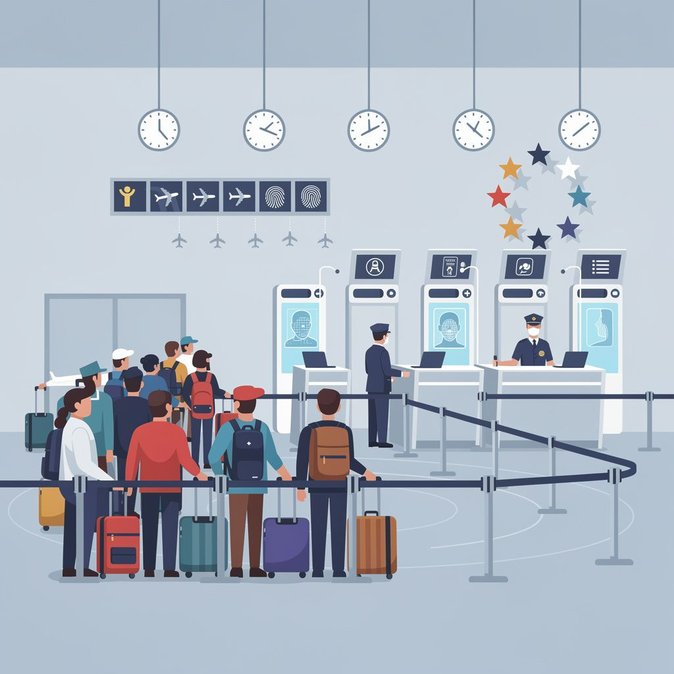
The EU’s new biometric Entry/Exit System (EES), fully activated in April 2026, is facing its first high-season stress test—and the results are painful. Travel industry portal The Traveler reported on 6 July that several Schengen airports recorded waiting times of up to three hours last weekend as non-EU passengers completed fingerprint and facial-image enrolment. Airlines for Europe (A4E), ACI Europe and IATA have sent an open letter to Commission President Ursula von der Leyen calling for the right to suspend biometric capture whenever queues exceed safe limits. Berlin-Brandenburg’s airport chief Aletta von Massenbach warned that non-EU travellers are already queueing for “up to two hours”—a situation she says is “unbearable over the summer” for Germany’s main capital hub. Long lines have forced some airports in Italy, Portugal and Greece to revert temporarily to manual stamping—a workaround theoretically available to all member states under Article 23 of the EES Regulation. German federal police (Bundespolizei) have discretion to apply the same measure, but so far have used it sparingly. For corporate mobility teams the chaos has immediate operational impacts: travellers unfamiliar with the system risk missing connections, and carriers are updating check-in deadlines—Lufthansa now recommends arriving four hours early for long-haul departures from Frankfurt if a first-time EES registration is likely. Employers should encourage staff to pre-register via national apps where available and to retain EES receipts for smoother exit processing on future trips. Strategically, Germany’s aviation lobby wants Brussels to allow a blanket suspension of mandatory biometrics until 1 October 2026. If granted, border authorities could focus resources on high-risk profiles while the IT agency eu-LISA fixes software glitches. A decision is expected at an extraordinary ministers’ meeting later this month; a negative outcome could see German airports join Rome in openly threatening unilateral suspensions—testing EU solidarity on digital borders.
Source: The Traveler