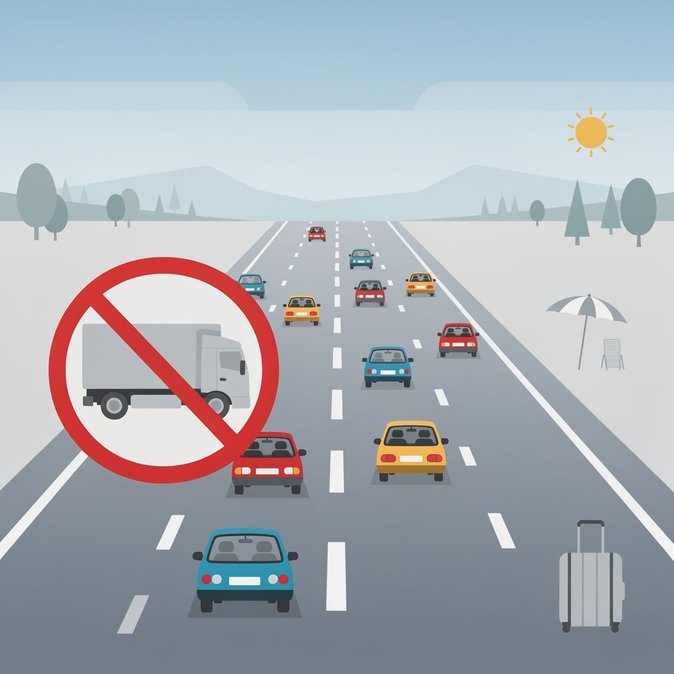
Germany’s annual Ferienreiseverordnung—the holiday-traffic decree—took effect this weekend, barring trucks over 7.5 tonnes (and articulated lorries with trailers) from 7 a.m. to 8 p.m. every Saturday between 4 July and 31 August. The restriction covers 22 of the country’s busiest Autobahn corridors, including the A1 through North-Rhine-Westphalia, the A3 between Frankfurt and Nuremberg, and the A8 from Karlsruhe to the Austrian border. Two federal highways (B31 and B96) are also affected. The aim is to free up capacity for the millions of holidaymakers heading to the North Sea, Alps and neighbouring countries. For business-travel planners and relocation firms the timing matters: nine Länder started school holidays this week, and long-distance traffic volumes are forecast to rise by up to 35 percent on peak Saturdays. While passenger cars will benefit from fewer slow-moving HGV convoys, coach operators warn that rest-area parking will be even scarcer because lorries begin queuing from 6 a.m. Logistics companies have rerouted time-critical shipments to night windows or weekday slots; perishable-goods hauliers, military transports and emergency vehicles remain exempt. Corporate mobility managers should brief assignees arriving by car from the Netherlands, Belgium or Denmark that delays may still occur at traditional pinch-points such as the A7 Kassel hills and Munich’s A99 ring. Drive-time that spills past 8 p.m. can trigger fines of €120 and one licence point for HGV operators, whereas private motorists face only congestion costs. The ban is unlikely to disappear soon. The Federal Transport Ministry says it will evaluate extending the scheme if the EU’s climate-package proposals to shift freight from road to rail progress. In the meantime, foreign carriers delivering household goods to Germany’s expatriate community must factor in the Saturday blackout when scheduling moves, or apply for case-by-case exemptions from local road authorities.
Source: Ruhr24