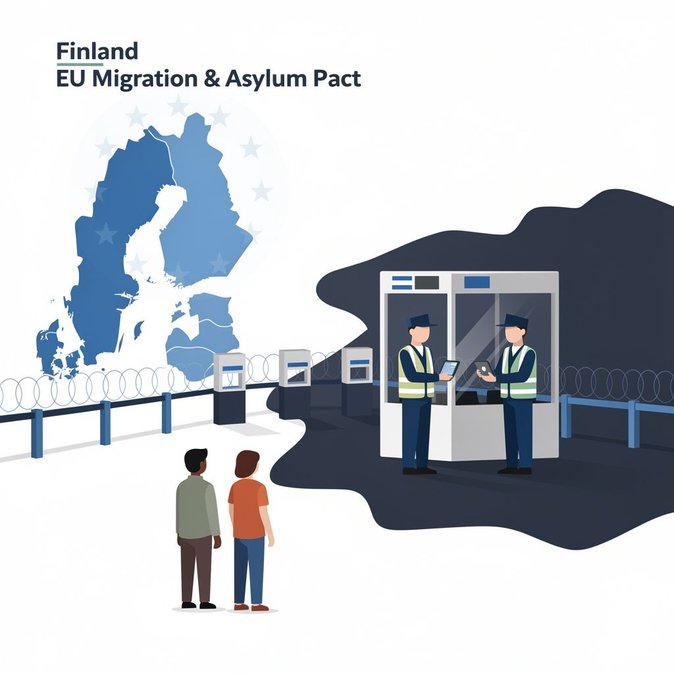
Finland’s Border Guard has carried out the first on-the-ground application of the European Union’s new Pact on Migration and Asylum, detaining and screening two third-country nationals who crossed the shuttered frontier from Russia near Ilomantsi on 6 July 2026. Under the pact, which became operational on 12 June, all irregular arrivals must undergo an initial security and health screening, biometric enrolment and Eurodac registration before their asylum claims are channelled into either normal, accelerated, border or return procedures. The incident is significant because Finland’s eight official road crossings with Russia have been closed since December 2023 amid what Helsinki describes as “instrumentalised migration” by Moscow. While overall asylum numbers have plunged, sporadic attempts to breach the 1 340-kilometre land border continue, compelling authorities to show that Europe’s common rules can operate even when formal checkpoints are shut. In this first case, the two migrants were transferred to a dedicated screening facility in Joensuu pending fingerprint checks and security vetting by the Finnish Security Intelligence Service (Supo). For employers who relocate staff through the eastern route—or operate projects in Russian border regions—the new mechanism means faster initial triage but potentially longer stays in containment centres if documentation is missing. The Border Guard has clarified that screening does not automatically imply detention, yet freedom of movement may be curtailed; corporate mobility teams should therefore build extra time into assignment schedules where emergency family reunification or humanitarian visas are involved. The rollout also marks a cultural shift for Finland’s immigration bureaucracy. Until now, the Finnish Immigration Service (Migri) handled most asylum registrations; under the pact, frontline officers collect data and run risk profiles before Migri opens a formal case file. Helsinki has invested €11 million in mobile biometric stations and additional staffing at temporary facilities along the Karelia region. Data flows directly into Eurodac, reducing duplicate applications elsewhere in the EU—good news for companies that rely on clear status verification when hiring displaced professionals. Legal advisers warn, however, that speed cuts both ways. The pact’s tight deadlines could see negative decisions issued within 12 weeks, triggering swift removals. Employers sponsoring talent with precarious protection claims should be ready to pivot to labour-based residence permits, which still sit outside the pact’s accelerated border procedure. Overall, the Finnish pilot offers an early glimpse of how the EU intends to combine tougher external-border policing with streamlined asylum processing—an approach likely to ripple across Schengen mobility planning for years to come.
Source: TKS News