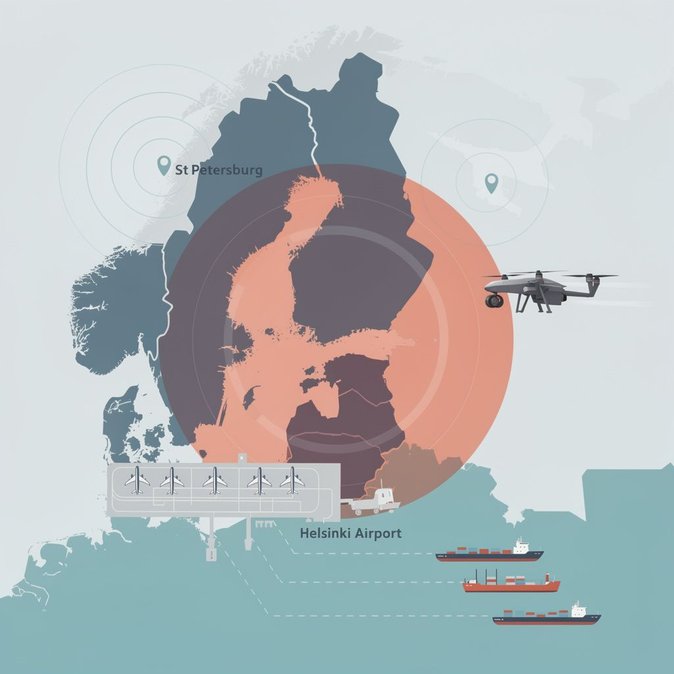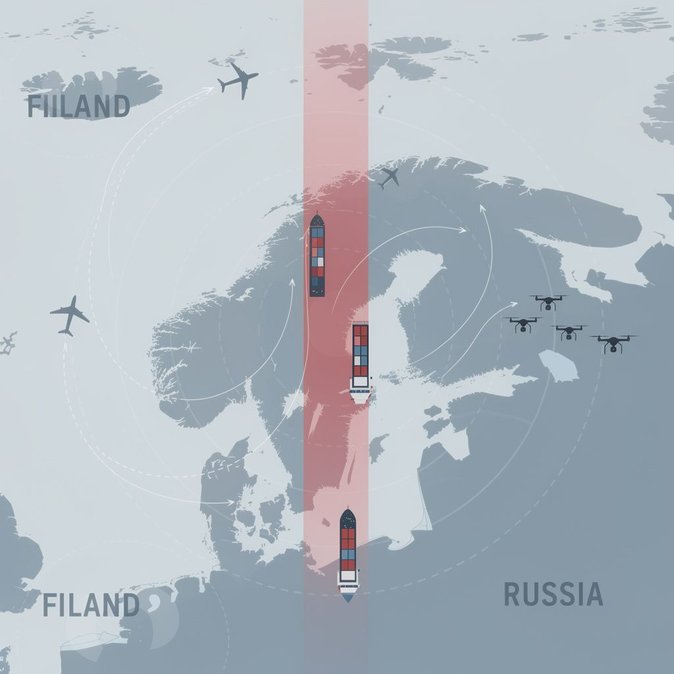
Finland’s Defence Forces imposed an exceptional two-hour no-fly and no-sail zone above the eastern Gulf of Finland at dawn on Monday, 6 July 2026, after Ukrainian long-range drones struck Russian oil terminals and ports near St Petersburg. The restricted area— stretching from Kotka’s coastline to the Russian maritime boundary and up to flight level 300—was activated at 06:00 local time and lifted shortly after 08:00 once radar sweeps confirmed no stray drones had entered Finnish airspace. Similar short-notice closures were ordered on 2 and 4 July, underscoring a pattern of rapidly rising air-security alerts along Finland’s southeastern flank. Although the window was brief, the measure forced at least four scheduled Finnair and Ryanair services to reroute north of the Gulf and delayed early-morning cargo departures from the ports of Hamina-Kotka and Vuosaari. Cruise operators sailing between Helsinki and Tallinn were instructed to hold position outside the zone; Tallink Silja reported a one-hour knock-on delay for its 07:30 shuttle. Airlines absorbed the disruption by adding an average 11 minutes of block time, but freight forwarders warned that repeated closures could erode Helsinki Airport’s reliability as a Nordic hub during the summer peak. The Finnish government says the restrictions are purely precautionary. Defence spokesperson Capt. Jere Paldanius told national broadcaster Yle that “dozens of Ukrainian drones have fallen short of Russian targets in recent weeks—our job is to make sure none of them endanger civilian traffic on our side of the gulf.” Since March, six unmanned aircraft believed to be Ukrainian have crash-landed in southeastern Finland, prompting a broader debate on counter-UAS technology and the need to harden critical transport corridors. Helsinki is already seeking €16 million in EU funds to expand coastal radar coverage and procure additional anti-drone jammers. For business travellers and logistics managers the message is to stay flexible. Finavia, the airport operator, has asked carriers to file contingency flight plans that avoid the restricted quadrant entirely, and shipping agents recommend adding 4–6 hours of buffer for time-critical cargo routed through Kotka or Vuosaari. Travel-risk advisers also note that temporary airspace closures can trigger insurance exclusions; multinational firms should verify that “war-risk” clauses do not invalidate employee cover while transiting Finnish territory. Looking ahead, officials hint that pop-up closures could become semi-routine if drone warfare around St Petersburg intensifies. The Ministry of Transport is drafting a fast-track NOTAM process with neighbouring Estonian and Swedish agencies so that carriers receive coordinated reroute guidance within 30 minutes of any new threat. Until a more permanent counter-drone shield is in place, corporate mobility managers should monitor Finnish NOTAMs and AIS advisories daily and consider alternative routings via Stockholm, Riga or Copenhagen for sensitive itineraries.
Source: Lentoposti