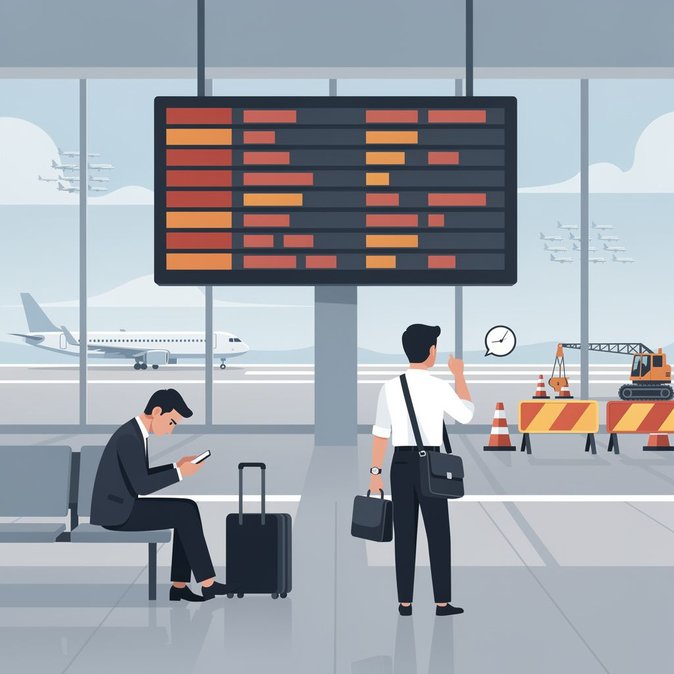
San Francisco International Airport (SFO) became a choke-point for returning Independence Day travelers on 6 July after the Federal Aviation Administration imposed a nationwide Ground-Delay Program aimed at managing runway-capacity constraints. FAA advisories listed average arrival delays of 54 minutes and maximum waits of 113 minutes; flight-tracking service FlightAware logged about 150 delayed movements by mid-afternoon. The immediate cause is runway work that forces SFO to increase aircraft-spacing on final approach—exacerbated by record holiday traffic (AAA estimated 5.85 million domestic air travelers over the 27 June-5 July window). Construction is scheduled through early October, meaning sporadic delays will persist well into the late-summer business-travel season. For corporate travelers, the disruption is more than an inconvenience. SFO is the primary trans-Pacific gateway for Silicon Valley, and late arrivals can trigger missed visa-activation windows, invalidated COVID-era health attestations still required by some Asian jurisdictions, and costly last-mile re-bookings. Companies should brief assignees to pad connection times, use carrier re-accommodation tools proactively, and consider routing through Seattle, Los Angeles, or Vancouver when feasible. Airlines are trying short-term fixes: United is up-gauging to larger wide-bodies on high-frequency domestic routes to maintain seat capacity without adding movements, while Delta has filed slot-control requests to shift some Tokyo and Seoul departures to off-peak hours. Long-term, analysts expect SFO’s runway-separation standard to remain permanent, a reminder that airport infrastructure can upend finely tuned mobility calendars. Travel-management companies recommend monitoring the FAA’s National Airspace System dashboard and signing up for carrier text alerts. Firms with critical meetings in the Bay Area this quarter may find it cheaper to fly teams in a day early than risk same-day connections—and to budget overtime costs for traveling technicians who face extended duty days.
Source: San Francisco Chronicle