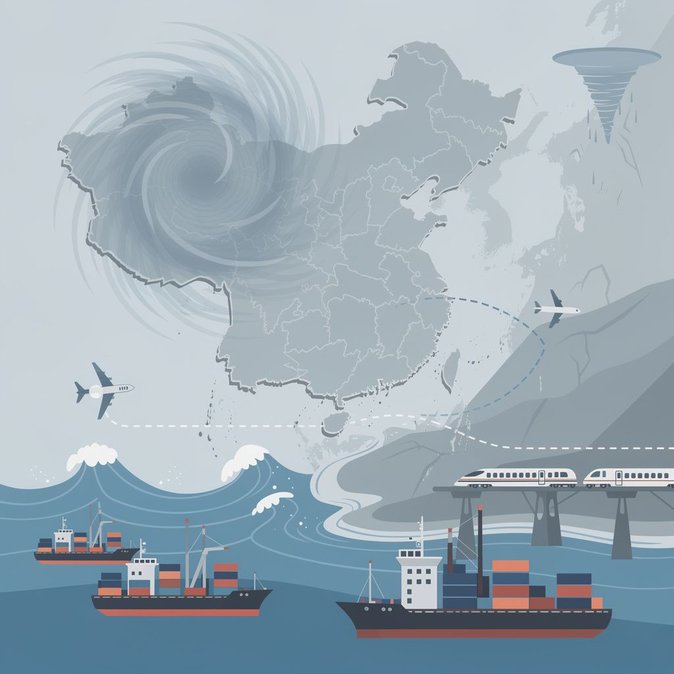
China’s disaster-response network is on high alert as Super Typhoon Bavi – currently packing sustained winds near 290 km/h – tracks across the Philippine Sea toward the Taiwan Strait, with landfall on the mainland projected between Zhejiang and Fujian late on 11 July. The warning comes on the heels of a punishing week of weather extremes that has already killed at least 11 people in Hubei tornadoes and left 16 missing in a Gansu landslide. Travel and mobility impacts are mounting. China Railway has suspended ticket sales for coastal segments of the Fuzhou–Hangzhou and Ningbo–Taizhou lines for 11–12 July, while China Eastern and Xiamen Airlines have introduced no-fee rebook policies for flights to 12 eastern seaboard airports. Shanghai’s Waigaoqiao container terminals are accelerating vessel departure windows to avoid berth congestion once Bavi’s approach forces closures. Risk consultancies point out that Bavi is forecast to coincide with peak summer manufacturing changeover, when many expatriate managers return from overseas to supervise new production runs. Companies with time-critical installation or compliance audits in East China should consider remote acceptance testing or shifting personnel via the inland hubs of Wuhan and Changsha, which lie west of the current forecast cone. Insurance underwriters expect a surge in claims for trip interruption, supply-chain delay and property damage, noting that 2026 has already produced record aggregated insured losses for the region before the main typhoon season even starts. Multinational firms are advised to review emergency communications trees and ensure that foreign staff registered with their embassies’ warden systems can receive SMS alerts once Bavi makes landfall.