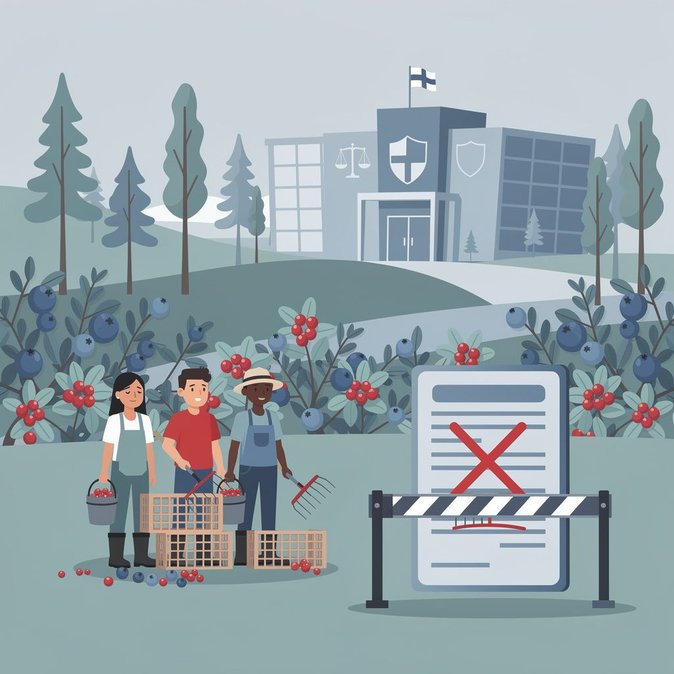
The Ministry for Foreign Affairs revealed on 7 July 2026 that more than 1,400 out of roughly 1,600 seasonal-work visa applications submitted this year for wild-berry picking in Finland have been refused. Most of the 2,200 total applications were filed at the Finnish Embassy in Bangkok, with smaller volumes lodged in Kazakhstan, Kenya, Vietnam, Nepal and India.
If you’re trying to navigate the tougher Finnish visa requirements, VisaHQ can streamline the process. Their Finland portal offers employers and individual pickers real-time checklists, digital application tools and live agent support, helping you pre-screen documents, secure embassy appointments and track every case in one dashboard—minimising the risk of costly refusals.
Officials say recent investigations, including 2025 supervisory-agency reports and ongoing criminal proceedings, point to systemic underpayment, overcrowded housing and unpaid debt arrangements that can trap pickers in conditions resembling forced labour. An amendment that brought berry picking under the Seasonal Workers Act in February 2025 made foreign pickers formal employees entitled to Finnish labour protections. This shifted responsibility onto Finnish berry companies to prove compliance with statutory pay, accommodation and health-and-safety obligations when sponsoring visas. According to Katja Luopajärvi, Director of the MFA Visa Unit, many sponsoring companies failed to satisfy those legal tests, prompting the mass refusals. For recruiters and the food industry, the sudden labour shortfall could raise procurement costs during the critical July–September harvest. Importers may have to pay higher farm-gate prices or switch to frozen stock, while restaurants and supermarkets will need to manage possible supply gaps in the prized bilberry and lingonberry categories. HR teams at multinational agribusinesses should also note that the Finnish authorities will undertake cross-agency inspections during the season; any signs of exploitation can lead to revoked work permits and corporate fines. The government stresses that legitimate operators still have a pathway to secure visas, but documentation must include written employment contracts, evidence of suitable housing, and proof of advance wage payments that at least match the 2026 sectoral collective agreement (€9.45/hour). Employers have been advised to arrange charter flights early and ensure pickers are registered in the Incomes Register prior to arrival to avoid delays at the border. Companies running international mobility programmes should brief Thai, Vietnamese and Nepali partners about the stricter review standards and build in longer lead times—visa processing that once took two weeks may now require six. Compliance teams should also monitor whether Finland’s move triggers similar crack-downs in Sweden and Norway, which rely on the same seasonal berry workforce.

If you’re trying to navigate the tougher Finnish visa requirements, VisaHQ can streamline the process. Their Finland portal offers employers and individual pickers real-time checklists, digital application tools and live agent support, helping you pre-screen documents, secure embassy appointments and track every case in one dashboard—minimising the risk of costly refusals.
Officials say recent investigations, including 2025 supervisory-agency reports and ongoing criminal proceedings, point to systemic underpayment, overcrowded housing and unpaid debt arrangements that can trap pickers in conditions resembling forced labour. An amendment that brought berry picking under the Seasonal Workers Act in February 2025 made foreign pickers formal employees entitled to Finnish labour protections. This shifted responsibility onto Finnish berry companies to prove compliance with statutory pay, accommodation and health-and-safety obligations when sponsoring visas. According to Katja Luopajärvi, Director of the MFA Visa Unit, many sponsoring companies failed to satisfy those legal tests, prompting the mass refusals. For recruiters and the food industry, the sudden labour shortfall could raise procurement costs during the critical July–September harvest. Importers may have to pay higher farm-gate prices or switch to frozen stock, while restaurants and supermarkets will need to manage possible supply gaps in the prized bilberry and lingonberry categories. HR teams at multinational agribusinesses should also note that the Finnish authorities will undertake cross-agency inspections during the season; any signs of exploitation can lead to revoked work permits and corporate fines. The government stresses that legitimate operators still have a pathway to secure visas, but documentation must include written employment contracts, evidence of suitable housing, and proof of advance wage payments that at least match the 2026 sectoral collective agreement (€9.45/hour). Employers have been advised to arrange charter flights early and ensure pickers are registered in the Incomes Register prior to arrival to avoid delays at the border. Companies running international mobility programmes should brief Thai, Vietnamese and Nepali partners about the stricter review standards and build in longer lead times—visa processing that once took two weeks may now require six. Compliance teams should also monitor whether Finland’s move triggers similar crack-downs in Sweden and Norway, which rely on the same seasonal berry workforce.