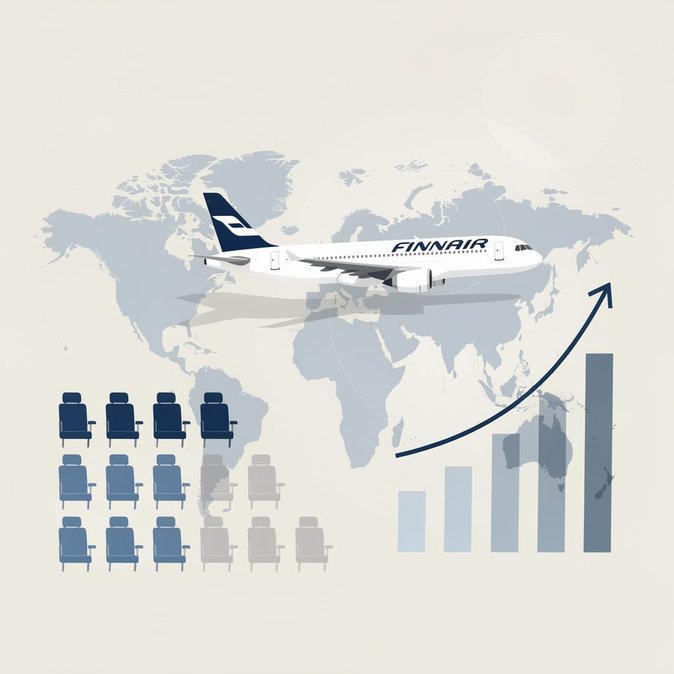
Finnair published its June 2026 traffic performance on 7 July, posting 1.19 million passengers—up 9 % year-on-year—and an 84 % system-wide load factor. Capacity measured in available seat kilometres (ASK) grew by 5.1 %, while revenue passenger kilometres (RPK) rose 7.9 %, indicating stronger yields. Growth was led by European (+10 %) and North Atlantic (+20 %) segments, aided by new Toronto flights and the return of corporate conferences in Western Europe. Cargo volumes also expanded 20.7 %, supported by pharmaceutical shipments from Brussels and express e-commerce flows from Hong Kong via Finnair’s A350 network.
Corporate travel teams juggling route changes and visa requirements can streamline the documentation process by partnering with VisaHQ. The platform’s Finland portal offers real-time entry rules, online applications and compliance tracking, ensuring that passengers on Finnair’s expanding network secure Schengen, U.S. ESTA or Asia transit visas efficiently—so itinerary planning revolves around seat availability, not paperwork.
On-time performance dipped to 74.8 % amid adverse weather across continental hubs—a data point travel managers should factor into service-level agreements. For mobility planners, the results signal a robust seat supply heading into the August–October expatriate relocation window. Finnair’s CFO Mika Stirkkinen confirmed that long-haul premium-economy cabins now account for 12 % of revenue and that the carrier will re-activate a stored A350 by September to meet Asia recovery demand. Higher PLFs could, however, tighten last-minute inventory in J-class, so corporates may need to book key project travel four weeks out. Finnair also reiterated that services to Israel and the wider Middle East remain suspended until security conditions improve, reallocating those aircraft to European charter work. The airline expects the Asia load-factor gap versus 2019 to close by Q1 2027 as overflight rights via China and Kazakhstan gradually return. Travel category managers should update budgets: Finnair’s internal forecast assumes a 5 % fare increase on trans-Atlantic routes in Q4 2026 as SAF blending mandates rise. Companies with Nordic HQs might consider volume commitments now to lock in current rates, particularly on newly launched Toronto and Osaka services.
Corporate travel teams juggling route changes and visa requirements can streamline the documentation process by partnering with VisaHQ. The platform’s Finland portal offers real-time entry rules, online applications and compliance tracking, ensuring that passengers on Finnair’s expanding network secure Schengen, U.S. ESTA or Asia transit visas efficiently—so itinerary planning revolves around seat availability, not paperwork.
On-time performance dipped to 74.8 % amid adverse weather across continental hubs—a data point travel managers should factor into service-level agreements. For mobility planners, the results signal a robust seat supply heading into the August–October expatriate relocation window. Finnair’s CFO Mika Stirkkinen confirmed that long-haul premium-economy cabins now account for 12 % of revenue and that the carrier will re-activate a stored A350 by September to meet Asia recovery demand. Higher PLFs could, however, tighten last-minute inventory in J-class, so corporates may need to book key project travel four weeks out. Finnair also reiterated that services to Israel and the wider Middle East remain suspended until security conditions improve, reallocating those aircraft to European charter work. The airline expects the Asia load-factor gap versus 2019 to close by Q1 2027 as overflight rights via China and Kazakhstan gradually return. Travel category managers should update budgets: Finnair’s internal forecast assumes a 5 % fare increase on trans-Atlantic routes in Q4 2026 as SAF blending mandates rise. Companies with Nordic HQs might consider volume commitments now to lock in current rates, particularly on newly launched Toronto and Osaka services.