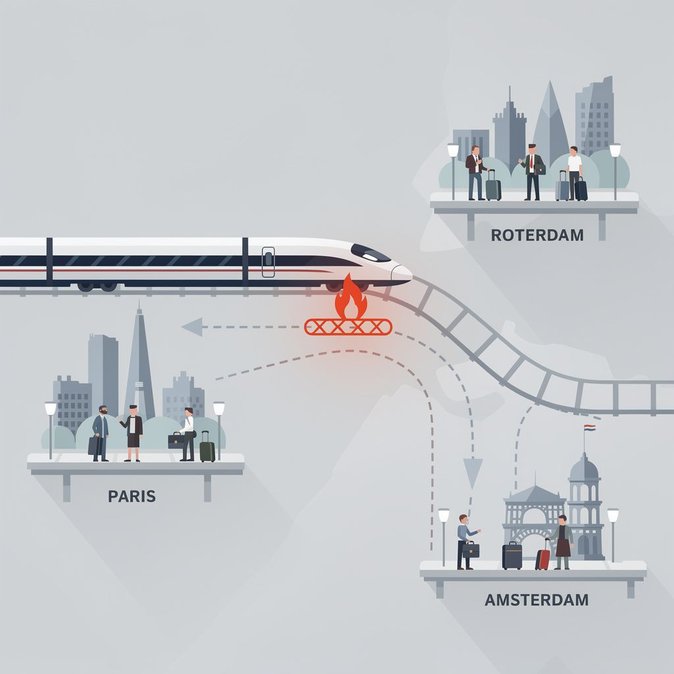
Dutch infrastructure operator ProRail announced on 7 July 2026 that repairs to the 300-cable trough damaged by a 29 June fire near Rotterdam Stadion are complete, allowing trains to resume. Eurostar, which cancelled or diverted services between London, Paris and Amsterdam for eight days, is gradually restoring its timetable—but warns that seat availability will remain constrained through at least 13 July while rolling stock and crews are repositioned.
For travelers suddenly needing to re-route through airports or add stops outside the Schengen Area, VisaHQ can arrange any last-minute visa or passport formalities. The company’s online portal lets corporate mobility teams verify entry rules, file applications and track progress in real time, helping employees stay compliant even when itineraries change at short notice.
The incident exposed the vulnerability of the Paris-Amsterdam corporate corridor: over 2,000 passengers per day—many business travellers connecting between French HQs and Dutch tech hubs—were forced onto flights or long-haul coaches. Companies reported additional hotel nights, missed meetings and urgent re-bookings on Air France/KLM shuttles. The disruption also spilled into Thalys (now ‘Eurostar Red’) services linking Paris, Brussels and Rotterdam, compounding knock-on delays at Paris-Nord. Eurostar is automatically refunding unused tickets and allowing free exchanges until 20 July, but traveller-tracking firms note that many corporate bookings were made via self-booking tools that do not pass on live disruption messages. Mobility managers should therefore cross-check PNRs and ensure affected employees are contacted. Looking ahead, ProRail will accelerate planned resilience works on key sections of the High-Speed Line South (HSL-Zuid). French and Dutch authorities have also ordered a joint audit of emergency-response protocols after firefighters took two hours to gain access to the tunnel section that caught fire—time that contributed to the extent of the damage. The episode serves as a reminder that high-speed rail, while greener than short-haul flights, is not immune to infrastructure shocks. Contingency planning—such as holding refundable hotel blocks near Brussels and Lille and maintaining airline-rail ‘dupe’ itineraries in traveller profiles—should be standard practice for firms that rely on the Paris-Benelux rail axis.
For travelers suddenly needing to re-route through airports or add stops outside the Schengen Area, VisaHQ can arrange any last-minute visa or passport formalities. The company’s online portal lets corporate mobility teams verify entry rules, file applications and track progress in real time, helping employees stay compliant even when itineraries change at short notice.
The incident exposed the vulnerability of the Paris-Amsterdam corporate corridor: over 2,000 passengers per day—many business travellers connecting between French HQs and Dutch tech hubs—were forced onto flights or long-haul coaches. Companies reported additional hotel nights, missed meetings and urgent re-bookings on Air France/KLM shuttles. The disruption also spilled into Thalys (now ‘Eurostar Red’) services linking Paris, Brussels and Rotterdam, compounding knock-on delays at Paris-Nord. Eurostar is automatically refunding unused tickets and allowing free exchanges until 20 July, but traveller-tracking firms note that many corporate bookings were made via self-booking tools that do not pass on live disruption messages. Mobility managers should therefore cross-check PNRs and ensure affected employees are contacted. Looking ahead, ProRail will accelerate planned resilience works on key sections of the High-Speed Line South (HSL-Zuid). French and Dutch authorities have also ordered a joint audit of emergency-response protocols after firefighters took two hours to gain access to the tunnel section that caught fire—time that contributed to the extent of the damage. The episode serves as a reminder that high-speed rail, while greener than short-haul flights, is not immune to infrastructure shocks. Contingency planning—such as holding refundable hotel blocks near Brussels and Lille and maintaining airline-rail ‘dupe’ itineraries in traveller profiles—should be standard practice for firms that rely on the Paris-Benelux rail axis.