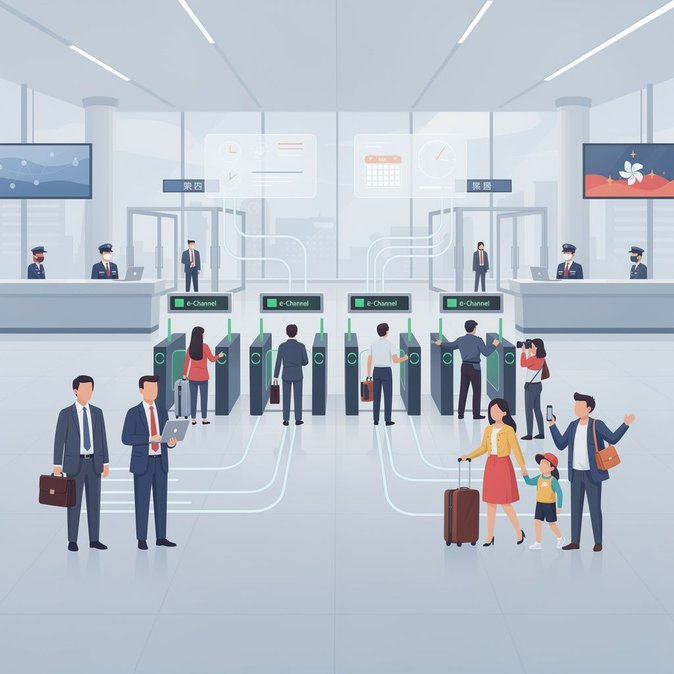
Hong Kong’s Security Bureau has laid out an unusually detailed blueprint for keeping the city’s land borders moving during peak travel periods, in a written reply to the Legislative Council on July 8. Officials conceded that long queues over recent long weekends—when some travellers failed to clear immigration before control-points closed—had dented Hong Kong’s reputation for efficient cross-boundary travel. Under the new approach, the Immigration Department (ImmD), Customs, Police and Transport Department will activate an inter-agency command centre during every major holiday. Leave for frontline officers will be frozen, extra e-Channels and temporary counters will be opened and bus frequencies to Shenzhen Bay and Lo Wu will be increased. Real-time data on passenger volumes will be pushed to the “Easy Boundary” website and HKeMobility app so that residents and tour operators can re-route coaches or advise clients to travel earlier. Long-term hardware upgrades are also accelerating. The first phase of works at Heung Yuen Wai raised the number of e-Channels from 14 to 18 last September, while Shenzhen Bay added four new arrival e-Channels in May. The Seamless e-Channel—Hong Kong’s first “walk-through” biometric lane—went live at the Hong Kong-Zhuhai-Macao Bridge port on 25 June and is slated for wider rollout once teething issues are ironed out. Meanwhile, redevelopment of Huanggang and Sha Tau Kok ports will adopt a joint-inspection model to allow travellers to clear both jurisdictions in one hall. Officials stressed that 98 % of Hong Kong residents are already processed within 15 minutes, but rising cross-border leisure and business trips—especially from the Greater Bay Area—mean the system must absorb additional spikes. Extended operating hours, first trialled over Lunar New Year 2024, will now be considered for all “golden week” holidays when demand warrants, subject to agreement with Shenzhen counterparts. For corporates, the measures promise shorter and more predictable transit times for staff commuting to Shenzhen tech parks or Dongguan factories. Travel managers are urged to integrate the Easy Boundary API into internal booking tools so that employees automatically receive wait-time alerts and suggested alternative checkpoints. The emphasis on data transparency and pre-event forecasting should also help tour organisers and cross-border coach operators optimise fleet deployment and staffing costs.