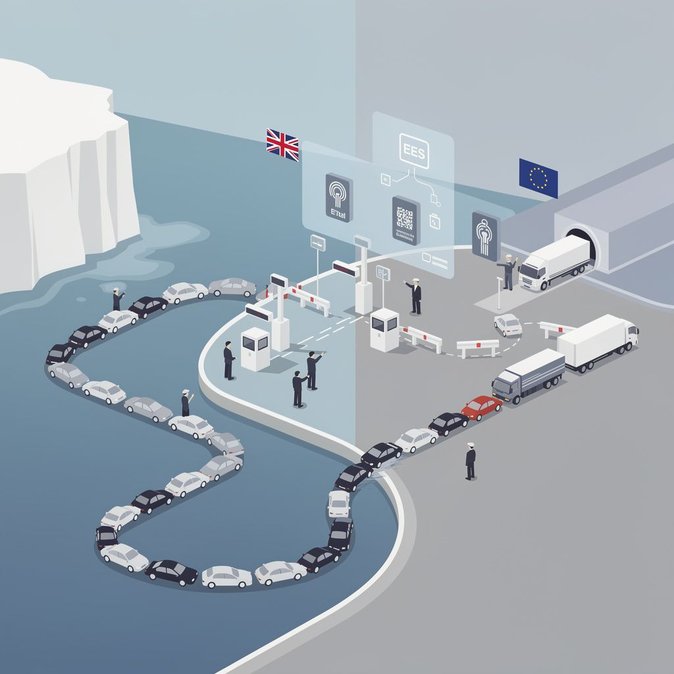
With the peak summer getaway days away, the UK Government has stepped up daily diplomatic pressure on French border police to use all flexibilities in the new EU Entry/Exit System (EES) when processing travellers at Dover and the Channel Tunnel. During an urgent debate in the House of Commons on 8 July – reported on 10 July 2026 – Border Security Minister Alex Norris told MPs that, when traffic volumes spike, authorities could face a choice “between keeping vehicles moving and fully applying the scheme”. The Port of Dover has warned that biometric registration – fingerprints and facial images captured by French officers before boarding ferries – could create queues of up to 12 hours, spilling back onto approach roads used by freight. Holiday car traffic can exceed 12,000 vehicles a day, dwarfing the 4.5-hour tailbacks already experienced during the May half-term. Paris insists the EES, fully live since April, is non-negotiable. Nevertheless, precedent exists: on 23 May French police temporarily switched to simplified checks to clear congestion. The UK is now asking for a similar “flow-first” protocol that would allow officers to defer full biometric capture once waiting times exceed agreed thresholds. For French mobility managers the pressure is two-way. Relaxed checks ease reputational damage for France as the Schengen entry point, but failure to apply EES rigorously could attract Commission scrutiny. Companies moving time-critical freight or coach tours between the UK and France should therefore monitor contingency measures such as Operation Brock on the M20 and build in overnight lay-overs where possible.
Source: Trans.info