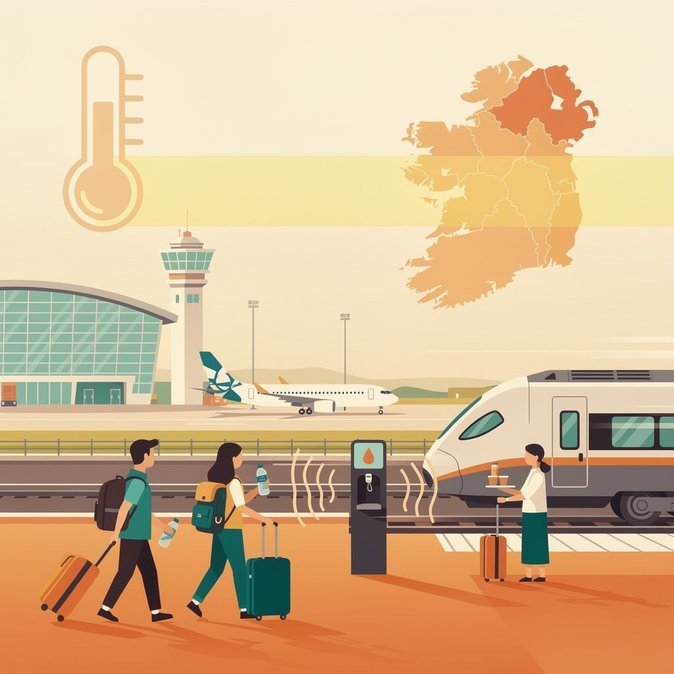
Met Éireann, Ireland’s national meteorological service, activated a Status Yellow high-temperature warning at 13:00 on Friday, 10 July 2026 for 13 counties, including Dublin, Cork, Galway and Limerick. The advisory—initially valid until 07:00 on Sunday—follows several days of unseasonably hot weather with daytime highs forecast to reach 29 °C and night-time temperatures unlikely to fall below 15 °C. Although Ireland’s Status Yellow alerts are the lowest tier in the colour-coded system, they nonetheless trigger specific contingency measures across the transport network. Dublin Airport Authority (DAA) confirmed it had activated its “hot-weather plan”, adding extra bottled-water stations air-side, deploying portable misting fans at immigration queues, and advising airlines to anticipate longer boarding times while ground crews work under heat-stress protocols. Irish Rail warned of precautionary speed restrictions on sections of the Dublin–Cork and Belfast Enterprise routes where track temperatures were expected to exceed 30 °C, potentially adding 10–15 minutes to journey times. Employers with inbound assignees or teams on short-term projects have been advised by the Health and Safety Authority (HSA) to allow flexible hours and provide ‘cool-work’ rest breaks in non-air-conditioned sites. The Department of Enterprise, Trade and Employment (DETE) issued guidance to companies scheduling immigration appointments at Burgh Quay and Intreo centres, noting that queuing will be outdoors for security reasons and recommending early-morning bookings where possible. The heatwave is already having operational effects: Aer Lingus delayed EI104 (JFK–DUB) by 40 minutes on Friday evening to balance payload against reduced air-density on Dublin Airport’s north runway, while Ryanair waived change fees for passengers booked on domestic Irish services through Sunday. Logistics providers DHL Express and UPS both released client notices flagging potential mid-day road-tanker restrictions on parts of the M7 and M8 if road temperatures breach the 50 °C skid-resistance threshold used by Transport Infrastructure Ireland (TII). For global mobility managers the key takeaway is forward planning. Staff arriving this weekend should be briefed to carry refillable water bottles (air-side fountains remain operational post-security), expect slower security and immigration processing during peak afternoon periods, and reconfirm ground-transport reservations. With further high-temperature days possible next week, contingency allowances—particularly for tight connection windows and time-sensitive project milestones—are strongly recommended.
Source: The Journal / Met Éireann