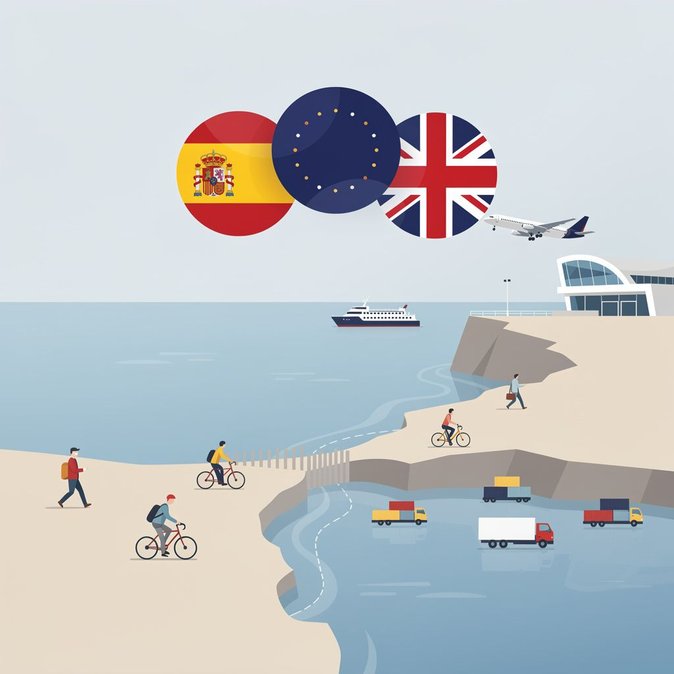
After four years of painstaking negotiations, Brussels and London signed the long-awaited EU-UK Agreement on Gibraltar on 14 July 2026. The treaty will demolish the 1.2-kilometre fence that has separated Gibraltar from La Línea de la Concepción since 1910 and will bring the British Overseas Territory under the rules of the Schengen area and the EU Customs Union. From the first minute of 15 July, travellers arriving by land, sea or air will undergo a joint Spanish-Gibraltarian control inside the airport terminal and the maritime port, while vehicle and pedestrian checks at the frontier will disappear. Spanish Guardia Civil officers, working alongside Gibraltarian police, will perform Schengen entry-exit controls; the UK will retain responsibility for visas and asylum inside Gibraltar but will no longer stamp passports at the land border. The deal guarantees what negotiators call “shared prosperity” for the 300,000 inhabitants of the Campo de Gibraltar and the 35,000 Gibraltarians whose daily lives have been dictated by the fence. Some 15,000 cross-border workers—many employed in Gibraltar’s finance and online-gaming sectors—will save up to two hours a day previously lost in queues. Businesses on both sides expect seamless supply chains: customs duties on most goods will be eliminated and veterinary inspections will be handled by a new joint facility at the port. Politically, Madrid underlined that Spain’s sovereignty claim “remains intact”, yet Foreign Minister José Manuel Albares hailed the accord as “the last loose end of Brexit”. The UK Government celebrated “an outcome that protects Gibraltar’s unique status while deepening co-operation with Spain”. In Gibraltar, Chief Minister Fabian Picardo called the treaty “a before-and-after moment” that safeguards self-government and ends physical isolation. For mobility managers, the agreement reshapes employee assignment strategies. Third-country nationals posted in Gibraltar will now need to meet Schengen visa requirements if they intend to cross into Spain, and Spanish immigration counsel should review workforce travel patterns. Companies operating bonded warehouses in Algeciras must update compliance procedures, as the Spanish Tax Agency has issued new import, export and transit codes effective immediately. Practical tips: 1) Cross-border commuters should register for Spain’s biometric e-gate programme to speed processing. 2) Logistics operators must replace ENS declarations with G4 transit entries for goods originating in Gibraltar. 3) HR teams should revisit remote-work policies—employees can now live on one side of the frontier and work on the other without daily passport checks.
Source: El País