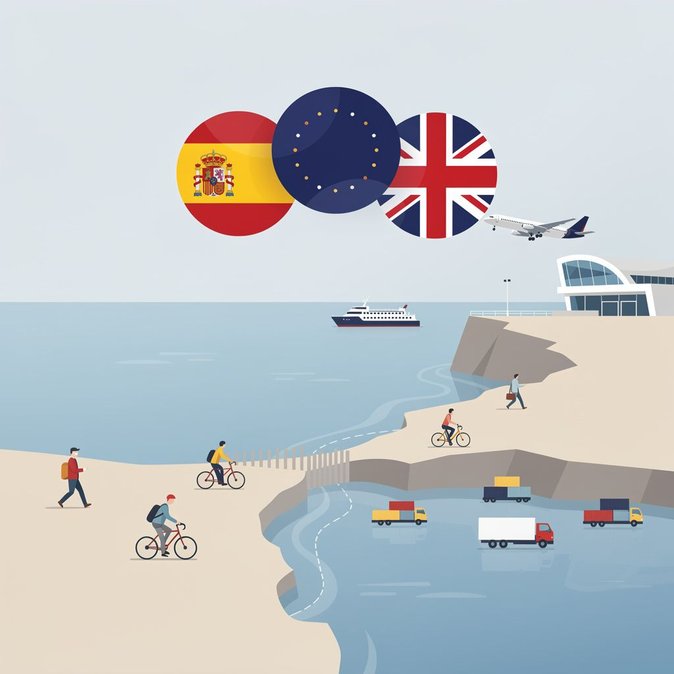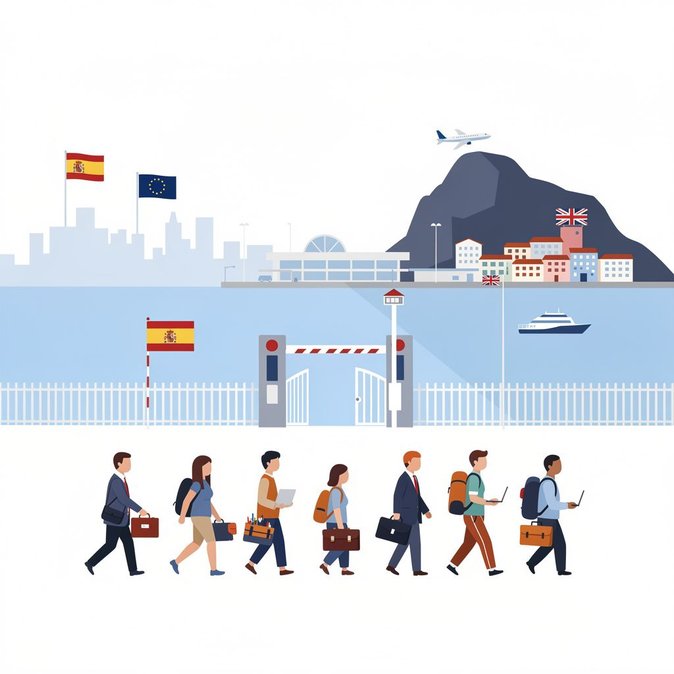
After four years of negotiations, the European Union and the United Kingdom signed the long-awaited Agreement on Gibraltar in Brussels on 14 July. The pact – witnessed by Spain’s foreign minister José Manuel Albares and Gibraltar’s Chief Minister Fabian Picardo – will demolish the century-old ‘Verja’ fence and fold the British Overseas Territory into the Schengen area for the first time. From 00:00 on 15 July, physical controls at the land crossing between La Línea and Gibraltar disappear; instead, full Schengen checks will be carried out by Spain’s Policía Nacional in Gibraltar’s airport and port, mirroring the juxtaposed model used at London-St Pancras. For the 15,000 cross-border workers – many employed in Gibraltar’s thriving financial-services and gaming sectors – the end of routine passport stamping is expected to cut daily commuting times by up to 40 minutes. Business organisations on both sides of the border predict that freer movement will enlarge the shared labour market and make it easier for Spanish service suppliers to take short-term assignments on the Rock. The agreement also abolishes customs controls on most goods, although sanitary and phytosanitary inspections will remain in place for agri-food items. Politically, the treaty leaves the question of sovereignty untouched, but it locks the UK, Spain and the EU into a joint governance committee that must agree any future legislative changes. Importantly for mobility managers, the text confirms that Gibraltar residents will be treated as third-country nationals under Schengen rules when they travel elsewhere in the EU, while EU nationals entering Gibraltar will benefit from facilitated procedures. HR and global-mobility teams should review posted-worker compliance: Spanish police will have real-time access to Schengen information systems, so overstays by non-EU contractors could now trigger automatic alerts. Companies should also update A1 and social-security coverage policies, as the accompanying Administrative Arrangements published by the UK Foreign Office spell out how contributions will be coordinated between Spain and Gibraltar. In practical terms, travellers crossing by car will notice little change apart from the absence of the barrier. During an initial six-month transition, Spanish and Gibraltarian authorities will maintain contingency lanes in case of IT outages in the new border-management system. Businesses moving goods should note the Tax Agency’s guidance that – as of 15 July – ENS safety declarations will no longer trigger temporary-storage notices; instead, entry declarations (G4) generated via NCTS must be used, and Gibraltar residents will have access to the Spanish DIVA VAT-refund kiosk network.
Source: El País