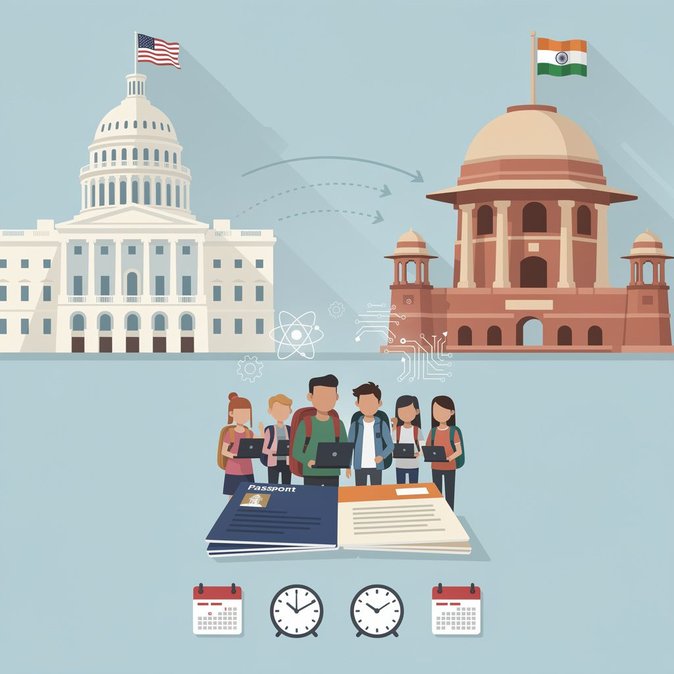
India’s Ministry of External Affairs (MEA) has moved quickly to open formal dialogue with Washington after the U.S. Department of Homeland Security (DHS) published a sweeping final rule on 17 July that will cap the period of admission for F-1 (students), J-1 (exchange visitors) and I (foreign media) visas at a maximum of four years. Under the current “duration-of-status” model, these non-immigrants are admitted for the length of their academic or professional programme and may extend their stay by updating records with their institutions; the new regulation will instead impose a fixed expiry date and require a fresh extension application, including biometrics and a new fee, to remain in status. Speaking at the MEA’s weekly briefing on 18 July, spokesperson Randhir Jaiswal confirmed that New Delhi had “taken note of the concerns raised by Indian students, researchers and journalists” and had already conveyed them to the U.S. Embassy in Delhi and to counterparts in the State Department. Officials are seeking clarity on grace periods, automatic extensions for STEM Optional Practical Training, and whether media professionals posted to the United States will receive waivers during breaking-news deployments. Indian nationals are the largest cohort of international graduate students in the United States—over 320,000 last year—and account for roughly 12 percent of J-1 exchange visitors. Education-technology firms, recruiting agents and corporate mobility managers worry that the four-year ceiling will complicate integrated master’s/PhD programmes and long-term industry placements. Media houses fear the rule could force costly mid-assignment renewals for correspondents. Corporate immigration advisers recommend that sponsors immediately audit programme lengths and build additional lead-time—DHS estimates 60–90 days—for Form I-539 extensions. Students beginning programmes in August have only a narrow window before the rule takes effect (60 days after Federal Register publication). The MEA has advised applicants to retain evidence of “uninterrupted full-time study” and to use CBP’s deferred-inspection offices if they encounter truncated I-94s at ports of entry. Strategically, New Delhi will likely leverage forthcoming Quad and Indo-U.S. Higher-Education Dialogue meetings to argue for research-linked exemptions and faster premium processing. Mobility managers should monitor these talks; if India secures a carve-out for STEM doctoral candidates—or persuades DHS to grandfather students admitted before the effective date—that could significantly soften the business impact.
Source: The Indian Express