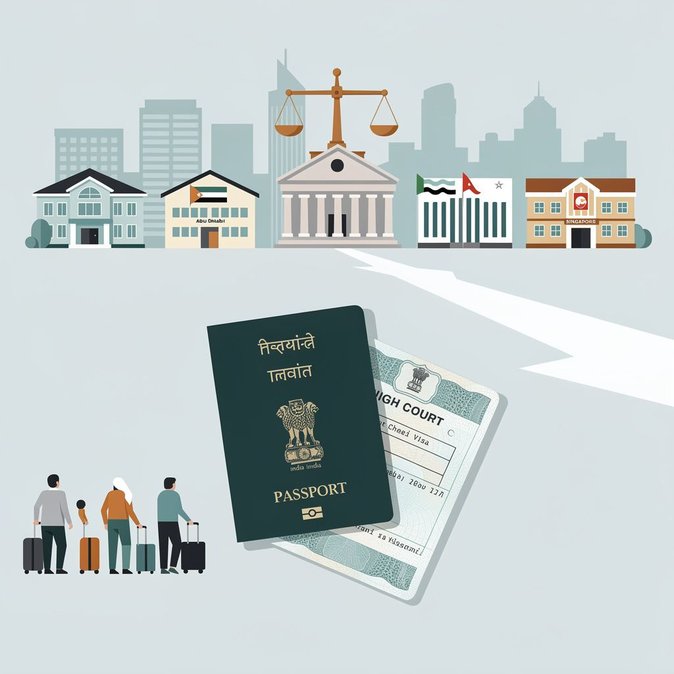
In a landmark judgment delivered on 20 July 2026, India’s Supreme Court dismissed the Union government’s appeal against a Delhi High Court order that had quashed the Ministry of External Affairs’ (MEA) global tender for outsourcing Consular, Passport and Visa (CPV) services at Indian missions in Abu Dhabi, Kuwait, Singapore and Canberra. The three-judge bench headed by Chief Justice Surya Kant concurred with the High Court’s view that the technical evaluation process was opaque, inconsistent and violative of the constitutional requirement of transparency. While refusing to restore the cancelled contracts, the Court acknowledged the business-critical nature of passport and visa delivery for millions of Indian expatriates and foreign travellers. It therefore authorised the MEA and Engineers India Ltd (the government’s project consultant) to put temporary service arrangements in place—either by extending existing vendor agreements or appointing an interim provider—until a fresh, legally compliant request-for-proposal is completed, ideally within three months. The dispute dates back to July 2025, when the MEA floated a multi-million-dollar tender covering 17 Indian missions but eventually awarded contracts for only four of them. Two losing bidders—E Trav Tech and Verasys—challenged the process, citing undisclosed benchmarking, arbitrary score deductions and unequal treatment across missions. On 15 July 2026 the Delhi High Court agreed, cancelling the awards and instructing the MEA to start over. The government’s immediate appeal created uncertainty for travellers and service partners worldwide. For corporates managing global mobility programmes, today’s verdict is a double-edged sword. In the short term, fragmented interim solutions may prolong application backlogs—especially in Australia, where VFS Global suspended new submissions from 1 July. However, the Supreme Court’s insistence on prompt, transparent retendering could ultimately produce a more predictable, tech-enabled CPV ecosystem. Mobility managers should advise employees to allow extra lead time for passport renewals or Indian visa applications routed through the four affected missions, and to monitor MEA advisories for pop-up service windows. More broadly, the ruling underscores India’s tightening judicial scrutiny of public-procurement governance. Future outsourcing contracts—whether for e-Visa platforms, border-control technology or FRRO case management—are now likely to carry clearer evaluation matrices, dispute-resolution clauses and performance safeguards, improving service quality for travellers and employers alike.
Source: LiveLaw