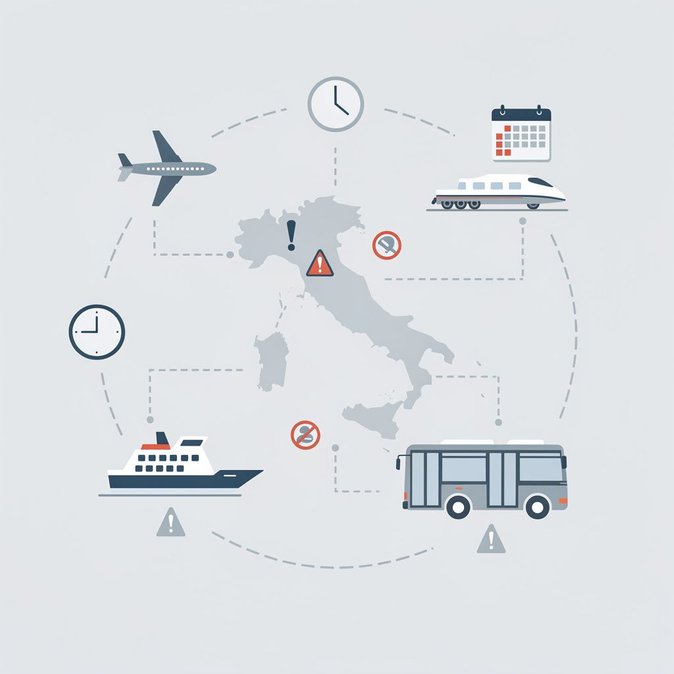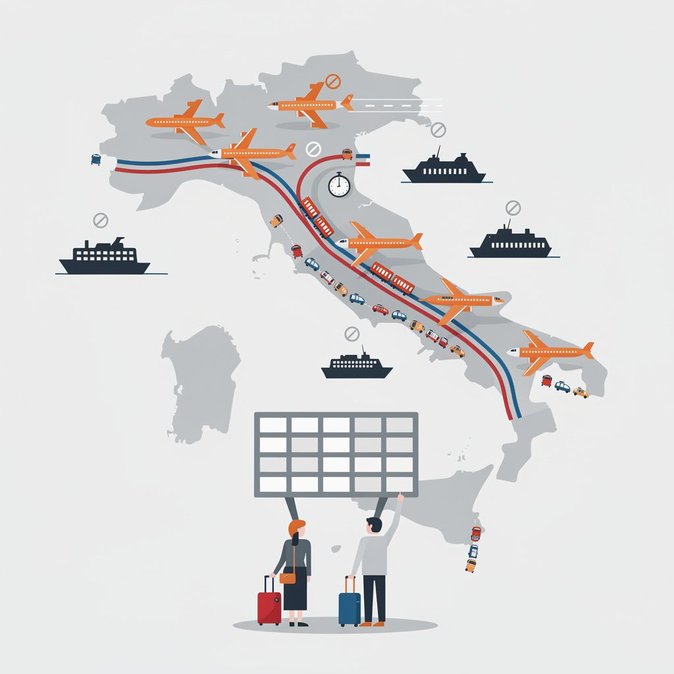
Italy’s summer travel season is off to a rocky start. At 00:01 on Tuesday 21 July, EasyJet cabin crew and ground staff across the country began a 24-hour national strike, marking the first of a series of coordinated labour actions that will hit every major mode of transport between 21 and 26 July. According to Italian daily Il Tempo, the walk-out is expected to affect hundreds of flights at Milan-Malpensa, Naples-Capodichino, Lamezia Terme, Palermo and other airports, even though the legally protected time-bands (07:00-10:00 and 18:00-21:00) should guarantee a skeleton schedule. The EasyJet stoppage is only the opening salvo. The national strike calendar compiled by the Ministry of Infrastructure and Transport (MIT) shows that ground-handling companies at several airports, urban bus operators in Genoa, Florence, Prato and Latina, and staff at ferry company Grandi Navi Veloci will stage their own actions through the week. On the rail side, unions representing workers at state-owned FS Italiane, open-access operator Italo and regional carrier Trenord have called a 24-hour strike from 21:00 on Thursday 23 July to 20:59 on Friday 24 July. Live departure boards at Rome-Fiumicino airport rail station already display warnings of «possible delays and service alterations» for the Leonardo Express and regional trains during the rail stoppage. Airlines are proactively cancelling flights and offering flexible re-booking, while Trenitalia and Italo have published the list of guaranteed trains that will operate during the strike. Why now? Unions accuse carriers of failing to adjust pay scales to inflation and of understaffing during peak season. Employers counter that the timing is designed to maximise disruption rather than foster negotiation. For business travellers, the immediate impact is the need to verify flight status, build in extra connection time and, where possible, switch to the protected time-bands or to virtual meetings. Practical tips: • Check airline apps and airport websites repeatedly in the 24 hours before departure; • If a flight is cancelled, EU 261 compensation does not apply when strikes are ‘extraordinary circumstances’, but passengers still have the right to rerouting or a refund; • For rail trips, consult Trenitalia’s and Italo’s «treni garantiti» lists; • If travelling by rental car, be prepared for heavier highway traffic as travellers shift away from air and rail.
Source: Il Tempo / Corriere della Sera