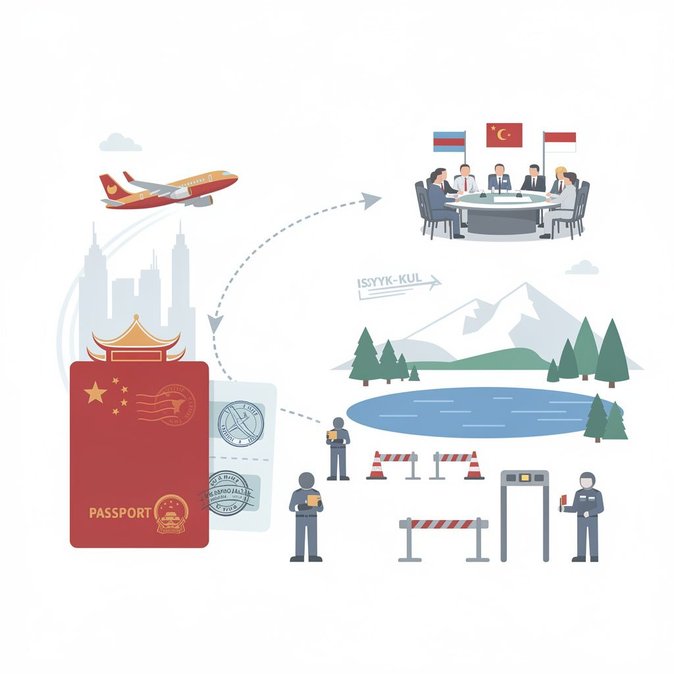
A Council of National Coordinators meeting wrapped up in Cholpon-Ata, Kyrgyzstan, on 23 July, finalising logistics for the Shanghai Cooperation Organisation (SCO) Foreign-Ministers summit scheduled for 24 July. The Chinese delegation, led by Foreign Minister Wang Yi, is expected to arrive on special-chartered flights later today, accompanied by a 120-strong press corps and support staff. Kyrgyz authorities have temporarily waived service-visa fees for accredited delegates and instituted fast-track screening at Issyk-Kul International Airport, illustrating how multilateral events can open ad-hoc mobility corridors even between countries that do not normally enjoy visa-free travel. China’s foreign ministry confirmed that all delegation members will carry diplomatic passports or official-duty visas pre-approved via an electronic exchange with Bishkek – a first for SCO events. Chinese logistics firms operating along the China–Kyrgyzstan–Uzbekistan corridor are watching the meeting closely; draft documents under discussion include a mutual-recognition arrangement for AEO customs status and a pilot e-permit for cross-border truck drivers. If adopted, these could shave days off door-to-door transit times for west-China factories shipping to Central Asia and Europe. For mobility managers, the immediate impact is advisory rather than operational: Chinese nationals travelling to Issyk-Kul over the next week should expect heightened security screening and possible road closures between Cholpon-Ata and Bishkek. Airlines have issued schedule-change alerts for flights CA7925/26 (Beijing–Bishkek) and CZ6021/22 (Guangzhou–Bishkek) on 24-25 July, citing airspace prioritisation for head-of-state aircraft. Longer term, the SCO’s push for digital visa platforms and harmonised driver-licence recognition could materially ease corporate postings in Central Asia. Companies with Belt-and-Road projects should monitor the summit communiqué for timelines and pilot-city details.
Source: SCO Secretariat