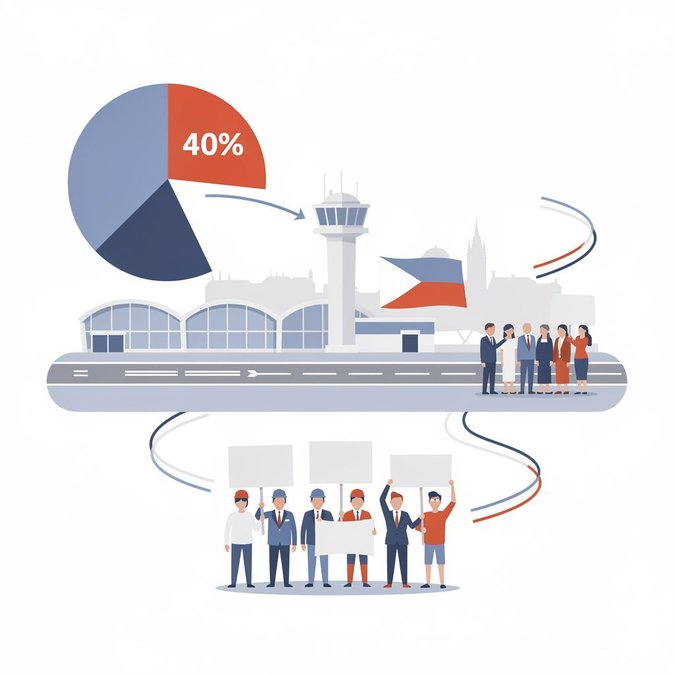
Five trade-union organisations representing ground-handling and technical staff at Václav Havel Airport Prague and its subsidiary ČSA Handling announced a formal state of strike readiness on 22 July 2026. The trigger was the government’s decision to install former Czech Airlines (ČSA) chief executive Radomír Lašák as the airport’s new chairman of the board. The unions say Lašák’s leadership of ČSA between 2006-2009 coincided with deep restructuring, asset sales and lay-offs that they believe accelerated the flag-carrier’s long decline. They fear a similar cost-cutting agenda at the state-owned airport, including possible outsourcing or partial privatisation, could endanger jobs, pay and service quality just as passenger volumes are returning to pre-pandemic highs. To date no concrete industrial action such as a walk-out or slowdown has been scheduled, but the move is a clear warning shot to the Ministry of Finance, which exercises shareholder rights on behalf of the state. Airport management and the finance ministry have tried to calm travellers and airlines, stressing that passenger processing, security, baggage handling and flight operations remain fully normal. Prague handled more than 16 million passengers in 2025 and is projecting record summer traffic in 2026; any disruption in peak season would ripple through airline schedules across Central Europe and the wider Schengen area. From a global-mobility perspective, the dispute is a reminder that labour relations at critical transport hubs can change quickly, affecting corporate travel and mobility programmes. Travel managers with assignees transiting Prague in the coming weeks should monitor developments, build in longer connection times and include contingency routings via Vienna or Munich if a strike date is set. Companies with local staff should ensure emergency contact trees and remote-work policies are up to date in case airport access becomes difficult. The unions have invited the ministry to immediate talks; if no agreement is reached they could escalate to a 24-hour warning strike that would halt check-in and ramp operations. While Prague Airport has contingency contracts with third-party service providers, large-scale substitution at short notice would be logistically challenging. Similar industrial actions this summer at Heathrow and Frankfurt underline the importance of early scenario planning for business travellers and global mobility teams.
Source: Aeroweb.cz