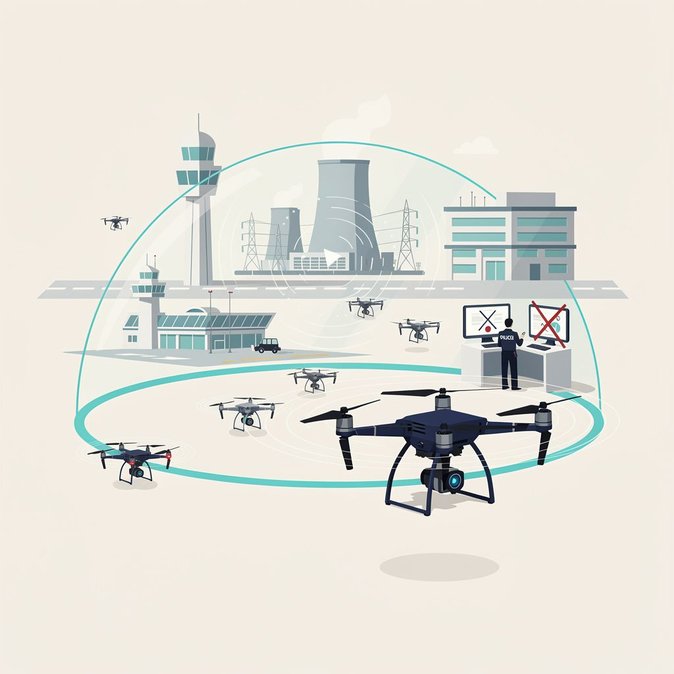
PRAGUE — The Czech government on 22 July 2026 released a draft bill that would dramatically expand “no-fly” zones for unmanned aerial vehicles (UAVs) and give police, airport operators and energy-sector security teams clearer authority to disable or confiscate rogue drones. Although the Czech Republic was an early adopter of EU-wide drone rules, lawmakers and regulators say several near-misses around Václav Havel Airport Prague and a spate of unauthorised flights over power stations have exposed gaps in the current regime. Under today’s rules, violating pilots can be fined or have their aircraft seized only after lengthy administrative proceedings. The proposed legislation creates a two-tier protection system: a 3-km perimeter in which hobby drones must file flight plans in advance, and a 500-m “red zone” in which any unauthorised incursion can be met with proportionate counter-drone measures on the spot. Interior Minister Lubomír Metnar said the bill was drafted jointly with the Ministry of Transport after consultations with airport operators, the Air Navigation Services of the Czech Republic and the national electricity transmission system. “Our goal is not to stifle innovation but to make sure that a 1 kg quad-copter cannot bring an A320 full of tourists to a standstill,” Metnar told reporters, adding that Prague Airport processes up to 45 take-offs per hour in the peak summer season. The bill mandates real-time data-sharing between the police and airport surveillance radars and allows for signal-jamming in emergency situations. Business travellers and logistics companies operating fleet drones for inspection work will feel the impact immediately. Commercial operators will have to obtain an annual “critical-infrastructure permit,” backed by proof of liability insurance of at least CZK 10 million. Foreign pilots on short-term assignments will be able to apply online but will have to pass a rapid background check through the Schengen Information System before receiving an electronic clearance QR code. Industry groups broadly welcomed the clarity but warned that capacity constraints at the Civil Aviation Authority could create permitting bottlenecks. Ondřej Černý, head of the Czech UAV Alliance, urged the government to allocate extra staffing and to integrate the new rules into the EU-wide U-space digital traffic-management network now being piloted in Germany and France. “If everything moves to a single pane of glass, a French engineering firm flying in to inspect turbines in Moravia should not have to navigate an entirely separate Czech database,” he said. If passed by parliament in the autumn, the tougher regime would enter into force on 1 March 2027 after a six-month grace period. Companies planning aerial filming, construction surveys or last-mile cargo demonstrations in Czechia next year should therefore review flight schedules, update risk assessments and budget for the new permit and insurance costs.
Source: Prague Daily News