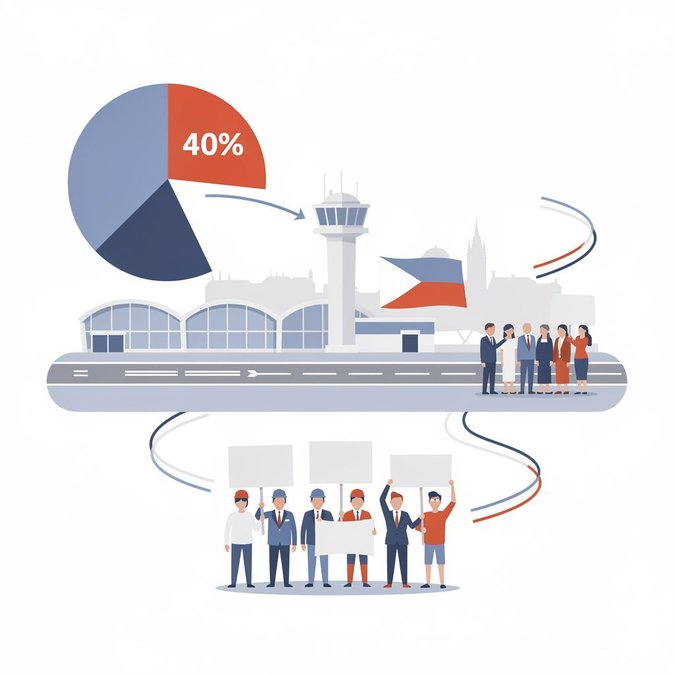
The Czech government has unexpectedly put Václav Havel Airport Prague back on the list of strategic state-owned companies that could be partially privatised. Speaking after the 23 July cabinet meeting, Prime Minister Andrej Babiš told journalists that an initial public offering (IPO) of “roughly 40 percent” of the airport operator is being considered for around 2028. Babiš stressed that the state would keep majority control but argued that selling a minority stake could raise tens of billions of crowns that would be reinvested into new runways, terminal modernisation and a long-delayed rail link to the city centre. Industry and Trade Minister Karel Havlíček added that an IPO would give domestic pension funds, Czech households and foreign infrastructure investors a rare chance to buy into a blue-chip Czech asset. Analysts quoted by the Czech News Agency estimate the airport’s enterprise value at CZK 50–65 billion, meaning the sale of 40 percent could generate around CZK 20–26 billion (EUR 800 million–1.1 billion). The proceeds, government officials say, would be ring-fenced for airport capacity upgrades and carbon-reduction projects rather than to plug short-term budget gaps. Unions representing more than 2,600 airport employees reacted cautiously. They remain on strike alert after a months-long dispute over management changes and fear that outside shareholders could push for cost-cutting. Finance Minister Alena Schillerová sought to calm concerns, saying no formal steps have been launched and that existing legislation requiring 100 percent state ownership of the airport would first have to be amended by parliament. From a global-mobility perspective, the announcement matters for two reasons. First, any capital injection could accelerate long-planned air-side and landside expansion, improving capacity for business travellers and cargo. Second, listing on the Prague Stock Exchange could impose stricter disclosure requirements on the airport, giving multinational travel-management companies clearer data on performance, fees and sustainability metrics. Practically, relocation-managers and corporate travel buyers should monitor the legislative timetable. If changes to the Airports Act are tabled later this year—as coalition sources suggest—the debate could offer clues on future landing-fee policy and slot allocation that will shape airline route planning into the 2030s. For now, the plan remains political, but its revival signals that Prague Airport’s ownership structure may finally change after a decade of on-again, off-again proposals.
Source: Expats.cz