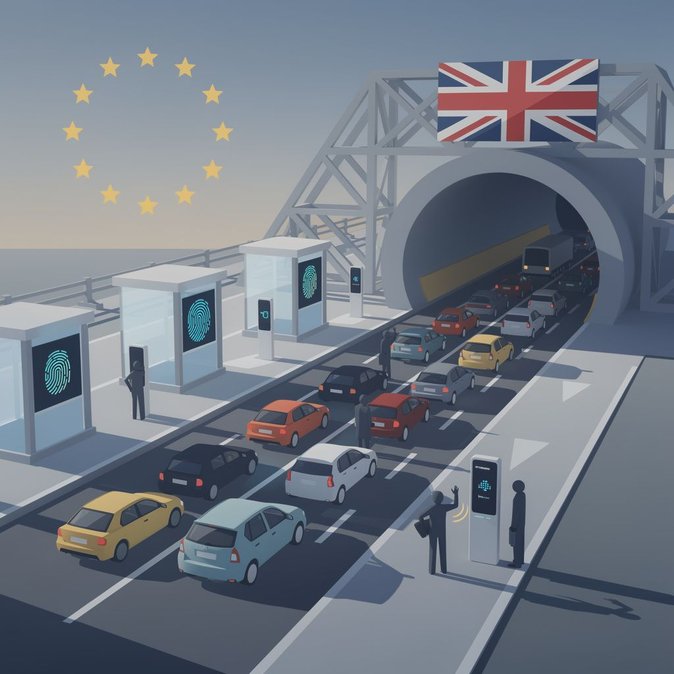
Getlink, the Paris-based operator of the Channel Tunnel, used its half-year results press call on 23 July to sound the alarm over the next phase of the European Entry/Exit System (EES). While the digital border regime has been live for airlines since April, the biometric component for car passengers is due to be switched on at French terminals in Folkestone and Calais on 6 September. According to chief executive Yann Leriche, the EU-supplied software that should link number-plate readers, passport chips and fingerprint scanners is still “not fully stable”. The Tunnel company has already sunk €80 million into 130 self-service kiosks and road-lane cameras designed to capture travellers’ facial images and four fingerprints without them leaving their vehicles. Tests carried out with the French Police aux Frontières (PAF) this month reportedly generated transaction times of more than 90 seconds per car—double the design target—raising fears of kilometre-long tailbacks at the height of the August getaway. Leriche said Getlink may have to ask Brussels for a derogation if the software is not patched in time, echoing similar warnings from airports and ferry ports. Under the Schengen regulations, France cannot unilaterally postpone the rollout. However, the European Commission can authorise local “soft launches” that rely on manual workaround procedures, provided the border authority can show it is working towards full compliance. Airlines and ferry companies are lobbying for such flexibility after chaotic scenes at Dover and certain French airports in May, when officers had to collect fingerprints by hand because tablets failed to synchronise. For business-travel managers the stakes are high. The Channel Tunnel handles one third of Franco-British freight and 60 % of all passenger vehicles crossing the Channel. Prolonged queues would disrupt just-in-time supply chains between northern France and the UK Midlands, and could force multinationals to reroute shipments via Belgium or fly critical staff instead of sending them by car. Getlink has nonetheless nudged its 2026 EBITDA guidance up to as much as €870 million, assuming “limited disruption” once EES goes live. That assumption now looks optimistic unless the software fix arrives before the seasonal traffic peak.
Source: Reuters via Euronext Live