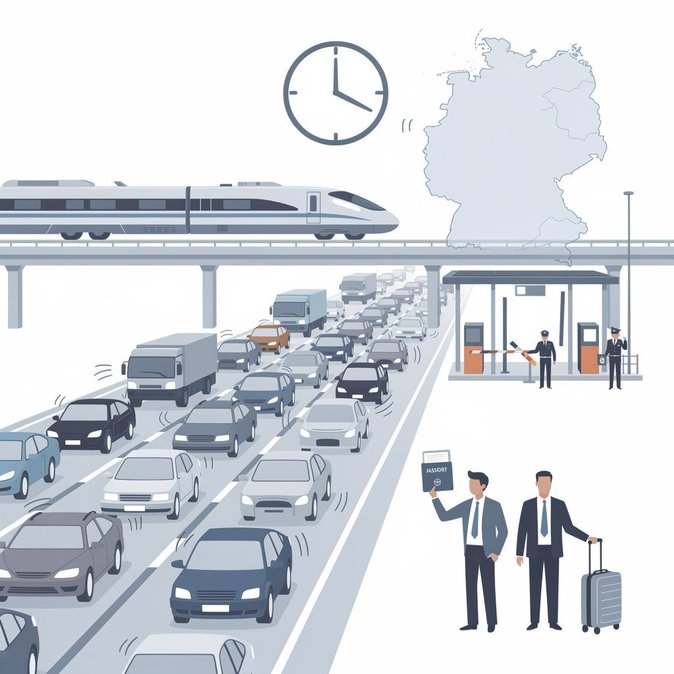
The Australian government’s Smartraveller portal, which aggregates official information from EU and German authorities, updated its Germany page on 24 July 2026 to confirm that “temporary border checks at all German land borders” will remain in force until at least 15 September 2026. The controls, first re-introduced in 2024 to curb irregular migration and secondary movements within Schengen, now cover crossings with Austria, Czechia, Poland, Switzerland, the Netherlands, Denmark, France and Belgium. Under the Schengen Borders Code, member states may revive internal checks for renewable six-month periods when faced with serious threats to public order. Berlin argues that high asylum pressure and people-smuggling networks justify the extension. While passport-free travel formally remains the norm, motorists and rail passengers must expect spot checks, and coach operators report dwell-time increases of 15-30 minutes on busy weekends. The advisory also highlights the impact of the new EU Entry/Exit System (EES), fully operational since April 2026. Non-EU travellers now have fingerprints and a facial image captured on arrival, a process that can lengthen queuing times at airports and land crossings — especially when coupled with the German controls. Business-travel associations have urged the Interior Ministry to deploy additional staff at major road corridors such as the A3 (Austria) and A12 (Poland) during the peak holiday exodus. For corporate mobility teams the message is two-fold. First, assignees driving between German sites and neighbouring EU offices should carry passports or national ID cards and allow buffer time for inspection. Second, HR should brief non-EU staff and clients about EES biometric enrolment, emphasising that no pre-registration or fee is required — a point that can help fend off phishing scams posing as “EES application” websites. Although the checks are officially temporary, Berlin has signalled that a further extension beyond September is possible if the long-negotiated EU Pact on Migration and Asylum (GEAS) is not yet fully implemented. Mobility managers should therefore plan for intermittent Schengen controls to persist into the autumn business-travel season.