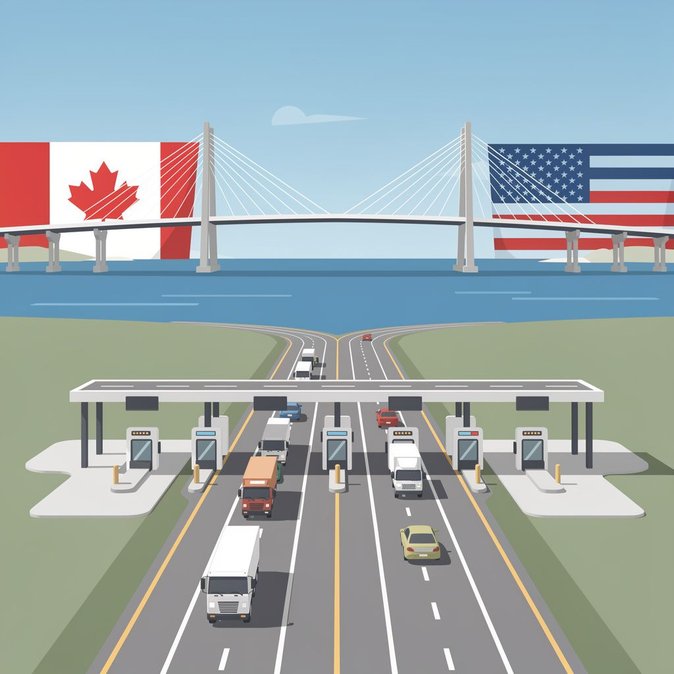
Canada quietly cut the ribbon on the Gordie Howe International Bridge in Windsor, Ontario, on July 24, 2026, ending a quarter-century saga to add a second crossing to the Detroit-Windsor trade corridor. Although last-minute U.S. tariffs forced organisers to scrap a joint ceremony, Canadian officials pressed ahead with a “Canadian Celebration” that saw Howe family members, provincial and federal leaders and local exporters take a first walk across the deck. The six-lane, 2.5-km span cost C$6.4 billion and will officially open to traffic at noon on Monday, July 27. Why it matters for mobility: Roughly 30 percent of all Canada-U.S. truck trade—about C$274 million every day—already moves through Windsor-Detroit. The new bridge’s dedicated 24 primary inspection lanes, re-configurable between commercial and passenger traffic, and its direct links to Highway 401 and I-75, are expected to cut crossing times by up to 20 minutes per truck at peak. For corporate mobility teams, the extra capacity provides a badly needed safety valve whenever the aging Ambassador Bridge or Detroit-Windsor Tunnel face closures or protests. The port of entry on the Canadian side is the country’s largest and most technologically sophisticated. According to the Canada Border Services Agency (CBSA), the facility includes fixed large-scale imaging, 12 commercial secondary docks, enclosed examination bays and dedicated NEXUS/FAST lanes. CBSA has trained 1,400 officers in the region and can redeploy staff between three Windsor crossings to match volume surges. Practical implications: Passenger cars will pay a C$5.75 one-way toll (C$4.35 for those enrolled in the bridge’s Breakaway programme). Commercial tolls start at C$24. Pedestrians and cyclists gain access on 5 August via a multi-use path. Travellers need the same documents required at other crossings—passport, NEXUS card or enhanced driver’s licence. Early-morning crossings remain the least congested, and CBSA reminds drivers that cannabis and most handguns remain prohibited. Strategic context: The opening arrives amid the sharpest Canada-U.S. trade tensions since 2019. President Trump’s threat this week to slap 50 percent tariffs on most Canadian goods meant no U.S. officials attended. Ottawa still expects the bridge to reinforce supply-chain resilience, especially for automotive and agrifood exporters, and to underpin North American competitiveness ahead of the 2027 renegotiation of CUSMA.
Source: Axios / Reuters / CBSA