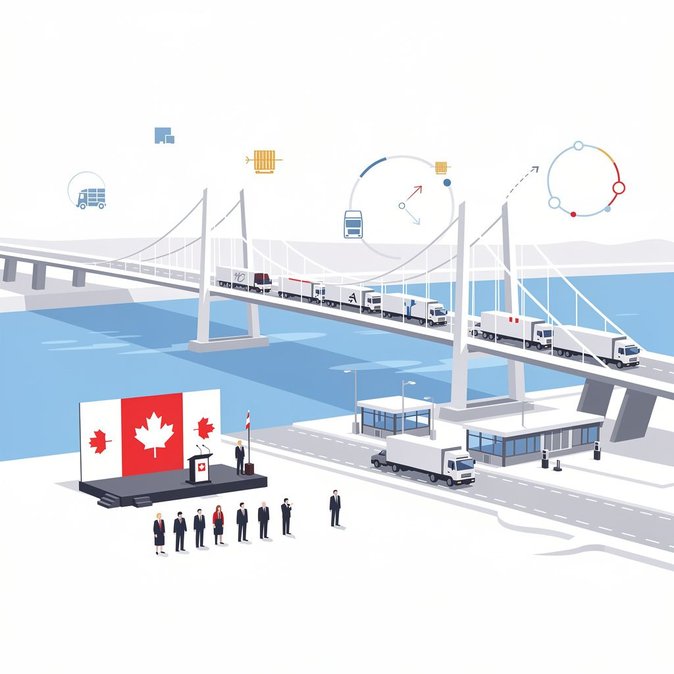
Canada held a solo ribbon-cutting event on July 24 for the C$6.4 billion Gordie Howe International Bridge linking Windsor, Ontario, with Detroit after a joint celebration was cancelled when U.S. President Donald Trump imposed new tariffs on Canadian goods. Despite the political drama, officials declared the six-lane, 2.5-kilometre cable-stayed structure ready for traffic at noon on Monday, July 27, promising faster crossings for both commercial trucks and leisure travellers. The bridge is Canada’s largest infrastructure project in a generation and has been two decades in the making. It boasts 24 reconfigurable Canadian inspection lanes, direct connections to Highway 401 and I-75, and tolls priced at C$5.75 per passenger vehicle—lower than the Ambassador Bridge or Detroit–Windsor Tunnel. The CBSA says the new port of entry was designed “from the ground up” for trusted-traveller programmes such as NEXUS and FAST, with dynamic lane-allocation technology to slash queuing times. Trade analysts note the opening could shift as much as 30 percent of cross-border freight away from the privately owned Ambassador Bridge, giving supply-chain managers redundancy and leverage in rate negotiations. However, the absence of a bilateral ceremony highlights the corridor’s sensitivity to trade tensions. Mobility teams should prepare contingency plans in case retaliatory measures affect customs processing or toll governance; the two countries are still hashing out a 15-year revenue-sharing framework. For business travellers the benefits are immediate: dedicated bus bays for cross-border shuttles, a multi-use path for cyclists and pedestrians opening August 5, and a Breakaway Program that discounts tolls for frequent crossers—a potential perk for commuter assignments in the auto and life-sciences clusters straddling Windsor and Detroit. Employers should brief travelling staff on document requirements identical to other land crossings and encourage early enrollment in NEXUS to maximise the bridge’s built-in efficiencies. Looking ahead, regional planners expect the Gordie Howe to unlock brownfield redevelopment on both riverbanks, spurring new industrial parks and expatriate housing. Companies weighing footprint expansions in the Great Lakes region may want to revisit site-selection models that assumed latent capacity constraints at the Ambassador Bridge.
Source: Axios Detroit