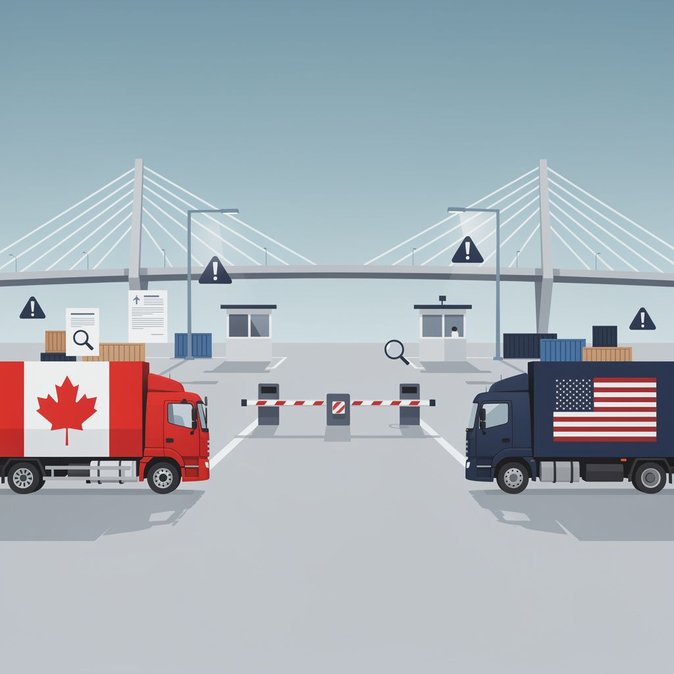
Canada’s cross-border business community woke up to fresh uncertainty on July 26 after Opposition MPs called for an emergency session of the House of Commons Standing Committee on International Trade. In a 6-page letter released at 4 a.m. ET, Conservative shadow minister for Canada-U.S. relations Shuvaloy Majumdar urged Prime Minister Mark Carney to table a written negotiating strategy that will protect exporters, travellers and supply-chain workers from a looming 50 % tariff the United States says it will impose in 30 days. Majumdar’s request follows U.S. President Donald Trump’s July 20 announcement that he will levy broad tariffs unless Canada lifts longstanding agricultural quotas and provincial liquor restrictions. The political volley comes just one day before the long-awaited opening of the CA$6.4 billion Gordie Howe International Bridge, an asset meant to speed the movement of more than C$400 million in daily trade across the Detroit-Windsor corridor. Companies that rely on “just-in-time” trucking fear a cascade of retaliatory measures that could slow freight inspections and raise costs overnight. Trade lawyers say a clear Canadian plan is essential. “Without certainty, carriers will hedge by re-routing freight through secondary ports, adding hours to transit times,” warns Montréal-based customs attorney Sophie Tremblay. Manufacturers with integrated North-American workforces are also concerned about employee mobility; many engineers and supervisors cross the border weekly under CUSMA business-visitor rules. Even a short-term tariff war could prompt U.S. immigration officers to scrutinise work permits more aggressively, legal observers add. Business groups are pressing Ottawa to reinforce NEXUS and FAST trusted-traveller lanes and to fast-track temporary work permits for supply-chain specialists who may need to shift production north of the border if tariffs bite. The Canadian Chamber of Commerce estimated in an overnight note that a 50 % duty on automobiles alone could put 90,000 Ontario jobs at risk. Meanwhile, the Prime Minister’s Office says it is “reviewing all options” and remains committed to opening the new bridge on July 27. For corporate mobility managers the next two weeks will be critical. Employers are advised to map alternative ports of entry, brief travelling staff on possible secondary screening and ensure that any goods hand-carried across the border have full commercial invoices. If Parliament reconvenes this week, executives should monitor testimony closely—it may signal whether border fluidity is about to tighten or whether cooler heads can reach a deal before tariffs take effect.
Source: CityNews / Canadian Press