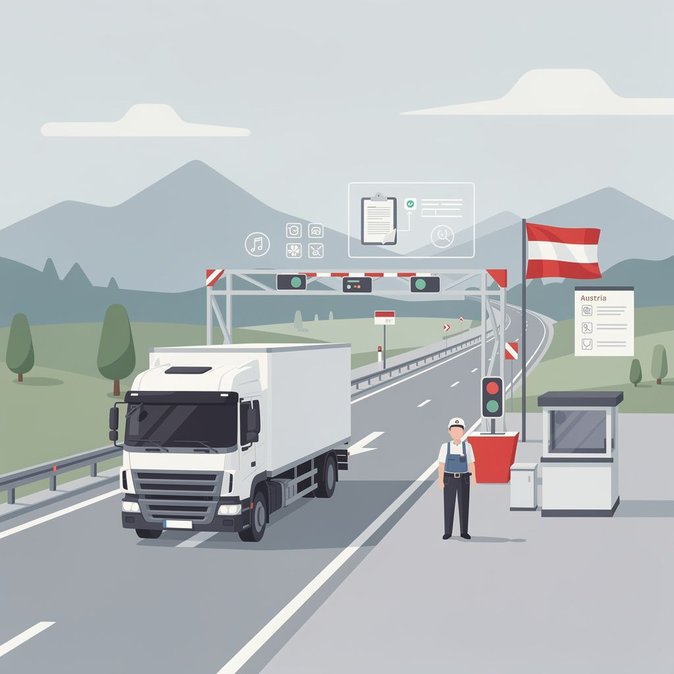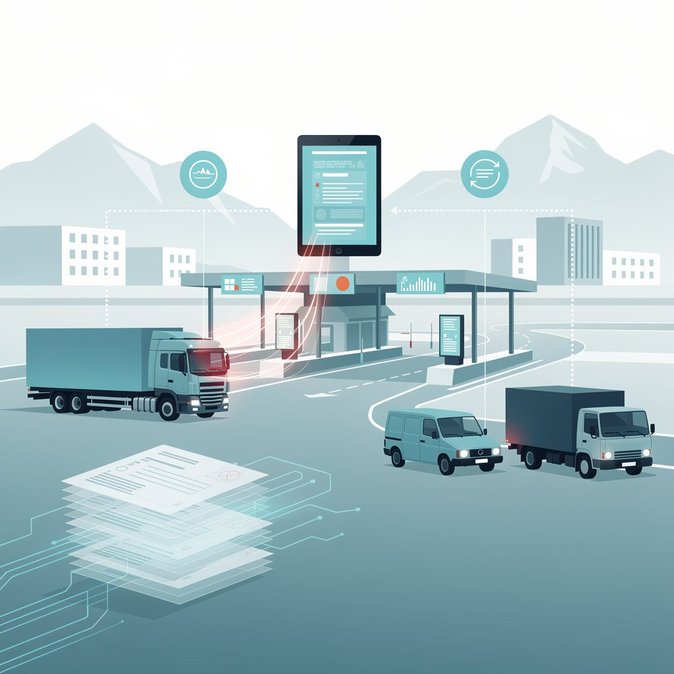
Austria has taken another decisive step toward fully digital border formalities. In an update published on 28 July 2026, the Federal Ministry of Finance confirmed that the Smart Border Austria platform—already in phased operation on the Swiss/Liechtenstein corridor—will become the sole, mandatory channel for all cross-border freight movements as of 1 December 2026. The announcement formalises the timeline for switching off the paper-based “Laufzettel” (transit slip) procedure and expands the programme beyond its current test sites in Vorarlberg. Smart Border Austria is an IT-driven border-management architecture that links economic operators’ logistics systems with Austrian Customs in real time. Truck licence plates and cargo data are pre-notified electronically (messages such as IEATBT44 and IEATBT51) and matched with automated number-plate recognition at six western border posts. Since July 2024, the “Goods Location Corridor – Entry & Exit” has handled imports and exports without stopping; a transit-entry module became obligatory on 1 January 2026. The latest schedule shows that the remaining Vorarlberg offices—Höchst, Mäder, Lustenau, Meiningen and Hohenems—will migrate to the digital workflow between 3 August and 22 September 2026, after which the pilot “Rolling Corridor” for through-traffic will follow. For logistics firms, the key takeaway is the hard stop on 8 September 2026: from that date, the transit-slip procedure will be discontinued entirely. Operators that have not yet integrated their enterprise resource-planning (ERP) or forwarding software with the Smart Border interface must accelerate their onboarding, obtain an Economic Operators Registration and Identification (EORI) number, and test message formats in the customs sandbox. Failure to transmit the mandatory IEATBT44 arrival notification before reaching the border will trigger fines and could cause queuing during the busy pre-Christmas season. Although the project is primarily freight-facing, business travellers who drive company vehicles across the Swiss or Liechtenstein border will notice leaner checkpoints as kiosks and manual booths are removed. The Finance Ministry estimates that end-to-end clearance times for a standard consignment will drop from an average of 28 minutes to under five once nationwide roll-out is complete. Trade bodies such as the Association of Austrian Freight Forwarders have welcomed the clarity of the new timeline but warn that smaller hauliers will need technical and financial support to comply on time. Customs officials stress that Smart Border Austria also delivers stronger security: digital footprints allow risk-based targeting and data sharing with EU systems such as ICS-2, the Entry/Exit System (EES) and—in 2027—ETIAS. For multinational companies with intra-EU supply chains routed through Austria, the message is clear: map today’s physical workflows to the new electronic corridor model, update driver instructions, and budget for last-mile IT tweaks well before the December hard launch.