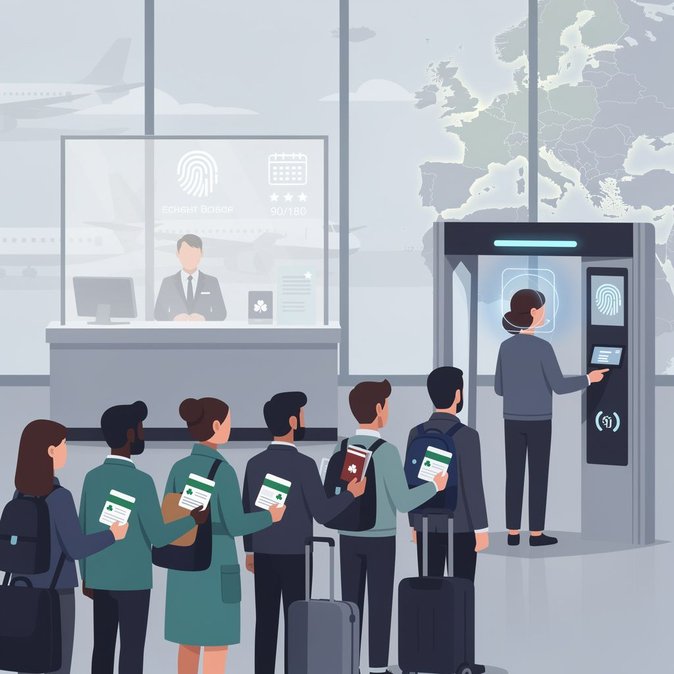
The European Commission quietly issued new guidance on 27 July clarifying who is—and who is not—exempt from the EU’s new Entry/Exit System (EES). Since the biometric border-control platform went live on 10 April, non-EU travellers have had mixed experiences as officials fine-tune the technology. The update matters to thousands of Ireland-based global assignees who carry Irish residence permits or long-stay ‘D’ visas but regularly pass through continental hubs for work. Under the guidance, holders of residence permits or long-stay visas issued by Ireland (and Cyprus) will be registered in the EES every time they cross an external Schengen frontier—even though Ireland is not part of Schengen itself. By contrast, EU nationals and non-EU family members with EU-issued residence cards remain exempt. The Commission says the distinction is necessary to track short-stay entitlements accurately and prevent ‘over-stay hopping’ between the Common Travel Area and Schengen zone. For mobility managers the practical takeaway is simple: build extra time into itineraries. Travellers with Irish cards should expect to supply fingerprints and facial images on first use, and subsequent automated gates will rely on that record. Airports such as Amsterdam Schiphol and Paris Charles-de-Gaulle have dedicated EES kiosks, but land borders (for example, French TGV stations) have reported queues of up to 45 minutes at peak times. Data protection teams must also brief employees: the system stores biometric and travel-history data for three years after the last exit, extendable to five if an over-stay alert is triggered. Companies moving staff between Irish and EU offices therefore gain a new compliance datapoint when calculating 90/180-day Schengen allowances. Failure to log EES days accurately could see employees refused boarding or fined on future trips. Irish travel trade bodies welcomed the clarity but urged Dublin Airport to accelerate its own e-gate upgrade so that connecting passengers do not face double biometric capture. The Department of Justice said it is “in ongoing discussions with EU partners” but gave no timeline for reciprocal recognition of Irish-collected biometrics. Until then, Irish residence-permit holders will need to join the EES queue like any other third-country national.