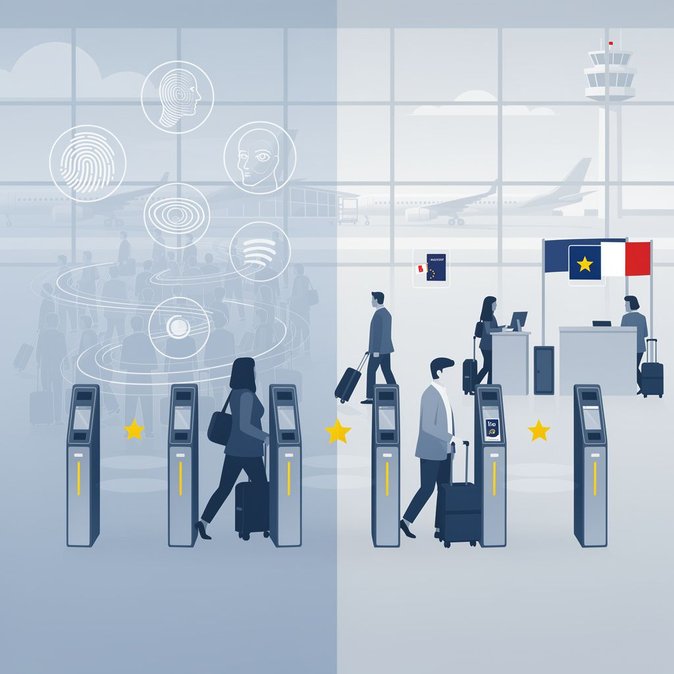
In a last-minute move aimed at averting gridlock at Europe’s external borders, the European Commission has quietly authorised France, Germany, Italy, Belgium, the Netherlands, Greece, Malta, Portugal and Switzerland to continue operating the new Entry/Exit System (EES) without compulsory biometric enrolment beyond the 6 September deadline. The decision, confirmed on 14 September 2026 by Brussels-based news outlet Biometric Update, allows border police at Charles-de-Gaulle, Orly and France’s 11 other international airports to rely on passport scans alone when queues exceed 30 minutes. Airlines and airport operators had warned that forcing every non-EU passenger to provide fingerprints and facial images during the autumn business-travel peak could push waiting times past two hours and jeopardise flight-connection integrity. Although the Commission insists the grace period is temporary, it represents a tacit admission that many member states, including France, are still struggling to install enough biometric kiosks and to integrate national police IT with the EU’s central database. Groupe ADP, which runs Paris-Orly and Paris-CDG, says only 57 % of its planned 420 kiosks are operational; the rest await software patches and certified data-protection audits. For multinationals moving staff through French hubs, the reprieve means fewer missed connections and a reduced risk that valuable Schengen visas will be invalidated by exit-stamp errors. Mobility managers are nevertheless advised to keep contingency buffers in itineraries, because the Commission has not set a new sunset date for the exemption and could reinstate full biometric capture with two weeks’ notice.
Source: Biometric Update