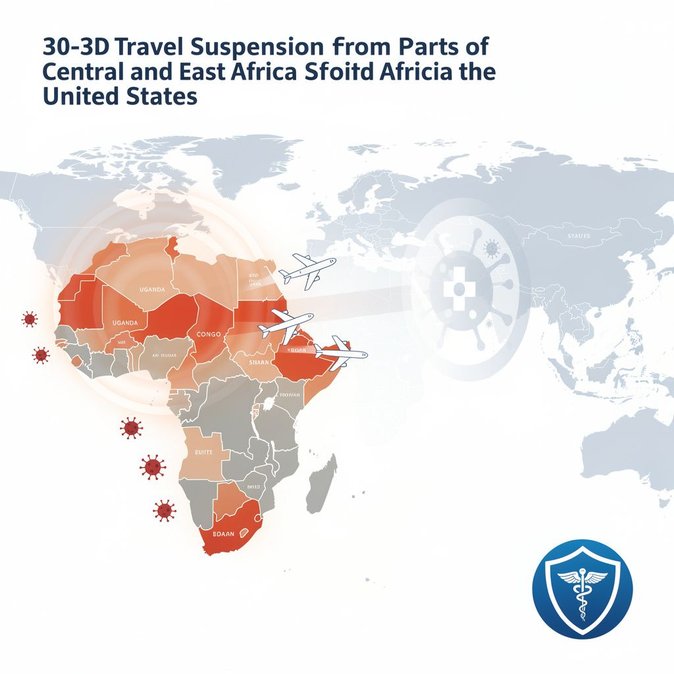
The U.S. Centers for Disease Control and Prevention (CDC) has renewed its emergency order under Sections 362 and 365 of the Public Health Service Act, continuing a full suspension of the “right to introduce” certain foreign nationals into the United States if they have been in the Democratic Republic of the Congo (DRC), Uganda or South Sudan during the previous 21 days. The notice, published in the 91 Federal Register 58673 on 16 September 2026, cites the escalating Bundibugyo-strain Ebola outbreak in eastern DRC and ongoing cross-border movements as the primary public-health risk. Under the order, Customs and Border Protection officers must deny boarding or entry to all covered travellers—including lawful permanent residents—unless they receive an individually approved humanitarian or law-enforcement exception vetted by CDC. U.S. citizens and nationals are exempt but remain subject to existing arrival-screening protocols. The measure is time-limited to 30 days but may be renewed repeatedly; the current extension runs through 11 October 2026. For mobility managers the extension revives pandemic-style complexity: flight routings that merely transit the listed countries are now high-risk, and travellers who do enter the region for business or humanitarian work will face automatic exclusion from the United States for three weeks after departure. Corporate travel teams should update booking tools to flag itineraries touching Addis Ababa, Nairobi, Doha, Istanbul or Brussels—major hubs linking the outbreak zone to U.S. gateways—and should pre-clear any urgent assignments with medical, security and legal advisors. The order also tightens resources at U.S. ports of entry. By shrinking the pool of arriving passengers CBP and local health departments can concentrate screening and isolation capacity on returning U.S. citizens, but mobility practitioners should expect longer processing times for exempt travellers and potential secondary inspections. Employers with assignees in Central and East Africa should review evacuation and telework contingencies, confirm that health insurance covers Ebola treatment abroad, and remind staff of in-country curfews and border-crossing closures that neighbouring governments may impose at short notice. Finally, the CDC’s renewed authority highlights an important compliance risk: violating the order—knowingly or unknowingly—can trigger immigration fraud findings that jeopardise future visa eligibility. Immigration counsel therefore recommend documenting all itineraries and maintaining proof of travel histories for at least 30 days after U.S. arrival.
Source: Federal Register