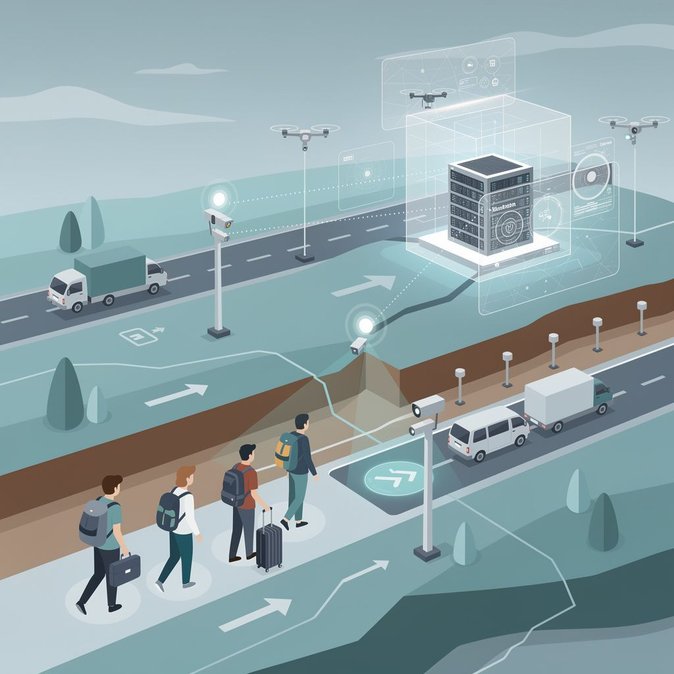
Germany is poised to take a technological leap in the way it monitors the Schengen borders it shares with nine neighbouring states. According to the official agenda published by the Bundestag, lawmakers will hold a first reading on 24 September of an Alternative-für-Deutschland (AfD) motion calling for a nationwide “Digitaler Grenzschutz Deutschland” (DGD). The proposal would require the federal government to draw up a risk-based, three-layer model that combines thermal and infrared sensors, ground-motion detectors, drones and AI-driven video analytics to identify irregular crossings in real time. Although the AfD sits in opposition, the debate comes at a moment when mainstream parties are also under pressure to show that they can manage migration flows without suspending freedom of movement permanently. Temporary controls introduced on Germany’s frontiers with Poland, the Czech Republic and Austria have now been prolonged several times, and Interior Minister Alexander Dobrindt (CSU) has repeatedly signalled that “smart” surveillance is the only sustainable way to reduce manpower-intensive spot checks without compromising security. If adopted in some form, the DGD would transform the Bundespolizei from a force that mainly checks documents to one that analyses thousands of sensor feeds. The motion envisages a new AI-supported national border-situation centre able to fuse data from local field units, drones and fixed installations. Companies specialising in video analytics, satellite connectivity and autonomous platforms are already lobbying for pilot contracts, while civil-liberty groups warn of mission creep and algorithmic bias. For corporate mobility managers and frequent business travellers the main takeaway is that physical spot checks are likely to give way to “invisible” digital vetting at rail corridors, autobahn crossings and even small regional airports. Compliance—valid travel IDs, up-to-date work permits and machine-readable documents—will become even more critical, because automated systems tend to flag any data mismatch instantly. Firms that regularly dispatch technicians across internal EU borders should prepare staff for occasional secondary screenings as the system is phased in. The parliamentary debate is scheduled for half an hour before the file is transferred to the Interior Committee; observers expect months of hearings before any amendments hit the statute book. Still, the fact that an AI-border concept is on the agenda at all signals that Germany is moving rapidly toward a technology-first model of migration management.
Source: Deutscher Bundestag