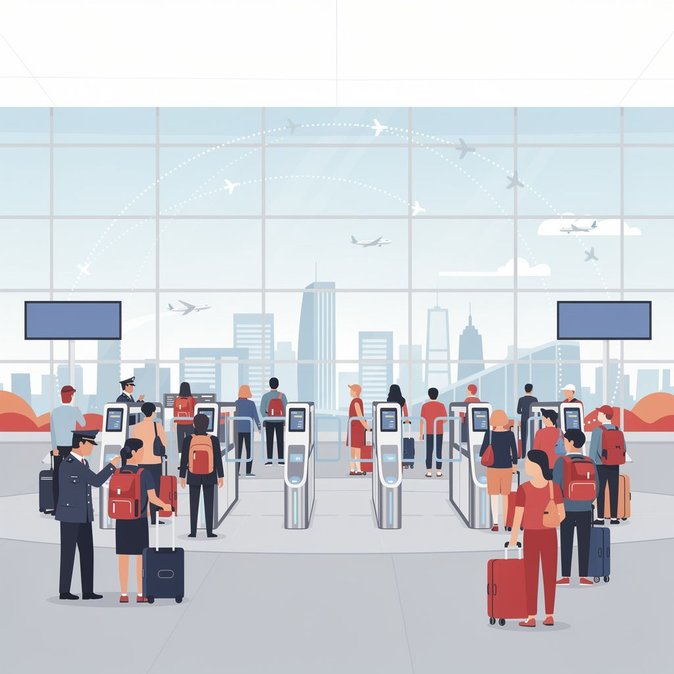
China’s National Immigration Administration (NIA) has ordered border-inspection stations nationwide to enter “peak-load” mode ahead of the Mid-Autumn Festival and National Day Golden Week, the twin holidays that will run consecutively from 28 September to 7 October. Passenger volumes are projected to hit a daily average of 2.25 million during Mid-Autumn and 2.15 million during the week-long National Day break, with single-day movements expected to surpass 2.4 million. The busiest crossings will again be in the Greater Bay Area, where Luohu, Shenzhen Bay, Futian and West Kowloon high-speed-rail checkpoints are all forecast to exceed 200,000 travellers per day. In a circular issued on 22 September, the NIA instructed local commanders to expand real-time passenger-flow monitoring, publish crowd-peak alerts through social-media feeds, and redeploy officers from quieter land ports to high-volume airports and rail hubs. A strict service standard—“no more than 30 minutes queuing for Chinese nationals”—has been set, with additional e-gates and mobile passport scanners being installed at selected terminals. Cooperation mechanisms with customs, transport operators and local police have also been activated to ensure rapid traffic dispersal once travellers exit the controlled area. For businesses moving staff in and out of China next week, the guidance offers welcome predictability. Many multinational companies schedule factory shutdowns or all-hands conferences around the ‘double-festival’ period, and reliable border throughput is critical for charter flights, bonded-truck convoys and time-critical air-freight. Travel managers are being advised to route peak-day arrivals through less-congested ports such as Shanghai Pudong’s satellite Terminal S2 or Zhengzhou Xinzheng, where spare capacity remains. The NIA’s forecast also signals how rapidly cross-border mobility has normalised since pandemic controls were lifted in early 2025. This year’s combined holiday surge will exceed 2023 levels by roughly 18 percent, moving the system close to its 2019 record. Officials say the upgraded digital passenger-flow dashboard piloted during May Day has now been rolled out to 310 ports, giving real-time visibility on queue lengths and enabling dynamic staffing. For corporate mobility planners, two practical points stand out. First, holders of the new 15-day visa-waiver from 46 countries should still prepare hotel and onward-ticket proofs—spot checks will rise during peak days. Second, companies with large holiday group movements should notify local border posts in advance; the NIA circular explicitly encourages pre-filing to unlock fast-track channels for groups over 100 people.