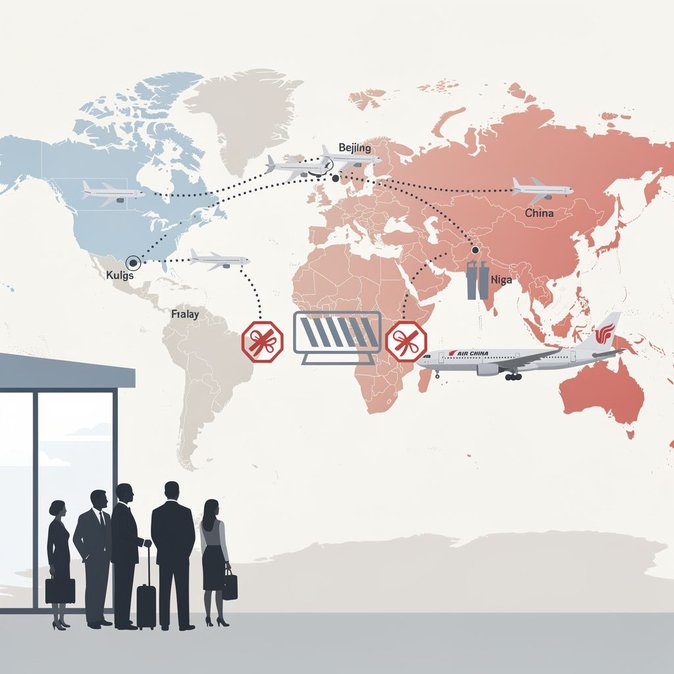
Airlines for America (A4A), the trade group representing major U.S. carriers, has filed a formal objection with the U.S. Department of Transportation (DOT) against Air China’s plan to operate additional Beijing–New York and Beijing–Washington Dulles flights in late September to carry Chinese delegations attending President Xi Jinping’s state visit. The filing, dated 21 September 2026 but made public on 22 September, argues that granting short-notice “event specific” flights could set a precedent that allows Chinese carriers to exceed the 24-round-trip weekly cap currently imposed under the U.S.–China civil-aviation détente. Air China operated an ad-hoc CA983 service to New York JFK on 19 September and has requested another for 25 September, along with a one-off Beijing–Washington flight timed for summit events. A4A says the move would “expand scheduled capacity under the guise of charters,” while U.S. airlines are still unable to fly their pre-pandemic frequencies because of Russian airspace restrictions that lengthen trans-Pacific routings. Behind the technical dispute lies an intensifying competition for lucrative premium-cabin demand tied to ministerial exchanges and multinational board meetings. Corporate travel managers had welcomed the prospect of extra seats—business-class load factors on U.S.–China routes have been running above 90 % since June—but warn that last-minute schedule changes could complicate travel risk assessments and travel-approval workflows. If the DOT sides with A4A, Air China could be forced to downgrade the extra flights to pure charters, limiting ticket sales to the Chinese delegation and accredited media, or cancel them outright. Conversely, approval could embolden both sides to request more “special event” flights, including for the Los Angeles Winter Games coordination meetings scheduled for November. Mobility advisers recommend that companies with executives booked on the tentative services prepare contingency routings via Vancouver or Seoul. They also note that diplomatic traffic often drives sudden capacity spikes, so monitoring DOT dockets has become a new task for global-mobility teams moving staff between the world’s two largest economies.
Source: CAPA – Centre for Aviation