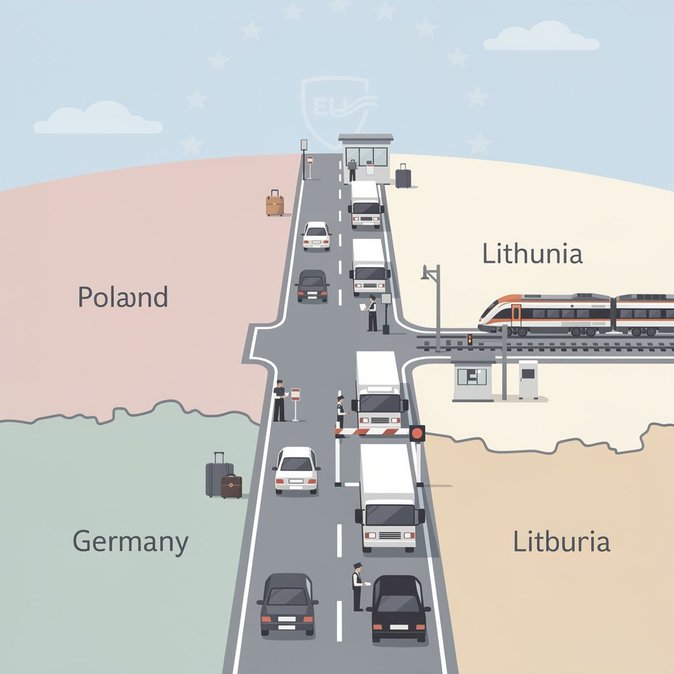
The EU Commission’s Schengen dashboard, updated on 1 October 2026, shows that Poland has notified Brussels of a fresh reintroduction of internal border controls from 2 October 2026 until 30 March 2027. The temporary measure will apply to all road and rail crossings with Germany and Lithuania and is justified by Warsaw as a response to “persistent migratory pressure” and secondary movements within the Schengen area. For travellers and logistics firms, the change means that passports or ID cards must again be presented when crossing the German–Polish frontier. Transport associations anticipate delays of up to 30 minutes for trucks at peak times, although Poland says that authorised transit lanes for commercial traffic will remain open. Airlines are not affected. Germany itself has maintained border checks on its southern and eastern land frontiers since 16 September 2026, citing similar security concerns and high asylum-application numbers. The overlapping controls underscore the ongoing fragmentation of Schengen free movement while member states wait for the new EU Asylum and Migration Pact to bed in. Businesses with frequent cross-border staff movements should allocate extra time, carry proof of assignment letters and ensure that work equipment corresponds to the “tools-of-the-trade” exemption to avoid customs issues. Long-term, the episode may accelerate calls for a joint German-Polish fast-track lane analogous to the German-Austrian “Green Lane” established in 2025.