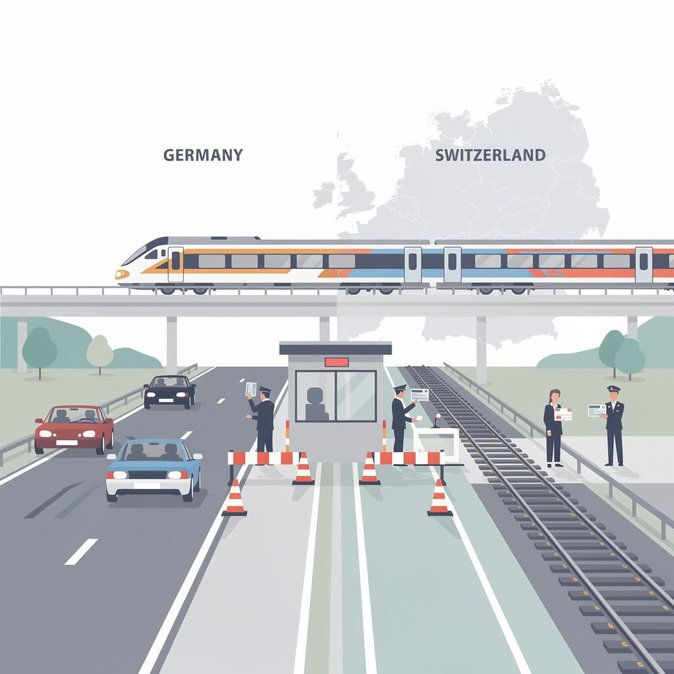
Germany’s Federal Ministry of the Interior has confirmed that the temporary controls it re-introduced along all of its land borders will remain in force for a further six-month period—from 16 September 2026 through 15 March 2027. The measure, first activated in 2024 to curb irregular migration, now explicitly covers the frontier with the Swiss cantons of Basel-Stadt, Basel-Landschaft, Schaffhausen, Thurgau, St. Gallen and Graubünden. Border officers are conducting ID checks on travellers arriving by road and rail and are empowered to refuse entry to persons lacking the right to stay in the Schengen area. Commercial freight is also subject to spot inspections, although dedicated “green lanes” remain open for just-in-time supply chains. According to the German authorities, the extension is justified by “continued serious threats to public security and order posed by high levels of irregular migration and migrant smuggling, and the strain on the asylum-reception system.” The European Commission’s live database of re-introduced controls was updated on 3–4 October to reflect the new expiry date. Switzerland, which normally enjoys passport-free travel with Germany under Schengen, has been informed via diplomatic channels. For Swiss companies with staff who commute or travel frequently to Southern Germany, the continued checks mean longer scheduling buffers are prudent—especially at the busy Basel/Weil-am-Rhein, Konstanz/Kreuzlingen and Singen/Schaffhausen crossings. Employers should remind assignees to carry a passport or national ID card as well as proof of residence permits. Logistics providers moving time-critical goods (pharma, fresh food, automotive parts) are advised to pre-alert drivers and use the green-lane procedure where available. The extension also has an immigration-compliance angle: Swiss nationals working in Germany on the basis of the Agreement on the Free Movement of Persons must be able to show their Anmeldebescheinigung or EU-Aufenthaltskarte on request. Third-country nationals resident in Switzerland require a passport plus Swiss residence card—and, if applicable, a German visa. The Federal Office for Customs and Border Security (FOCBS) has not mirrored the controls on the Swiss side, but it warns that travellers turned back by German police will be deemed not to have left the Schengen area.