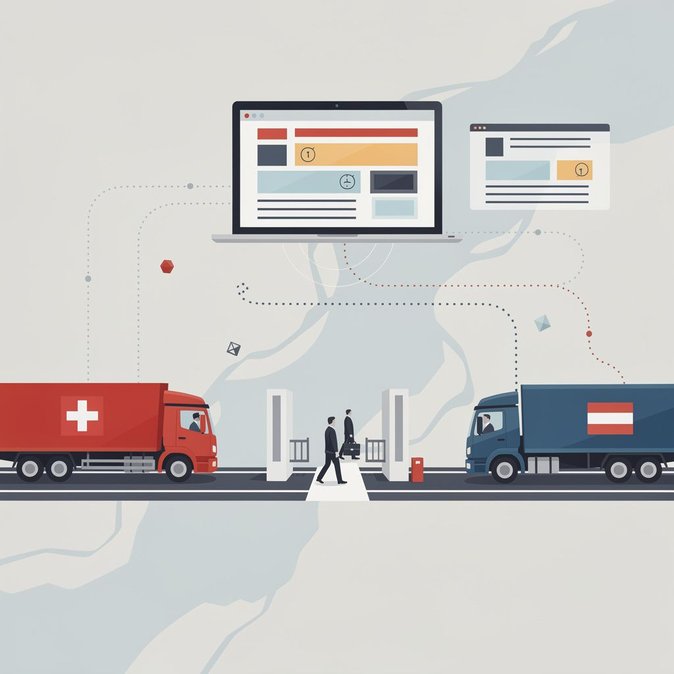
Truck drivers and logistics managers moving goods between Switzerland and Austria woke up to a very different border this morning. As of 1 October 2026, the Federal Office for Customs and Border Security (FOCBS) has switched several Rhine-valley crossings to fully-digital import and export processing, synchronising its systems with Austria’s newly-launched “Smart Border Austria” platform and Switzerland’s own Passar 2.0 customs IT upgrade. The change is most visible at the busy Wolfurt hub, where traditional on-site import clearance has been discontinued; all declarations must now be lodged electronically before arrival, with barcode or QR codes scanned automatically at the gate. FOCBS says the move will cut waiting times by up to 40 %, eliminate duplicate data entry and align Swiss-Austrian border procedures with upcoming EU Entry/Exit System requirements. Customs officers will focus on risk-based spot checks, while license-plate recognition cameras feed vehicle data directly into the Passar 2.0 risk engine. Forwarders that fail to pre-lodge data risk being diverted to secondary inspection sites in Diepoldsau or St. Margrethen, potentially adding hours to transit schedules. For Swiss exporters—especially pharmaceuticals and precision-machinery firms clustered around St. Gallen—the biggest adjustment is paperwork timing. Commercial invoices, proof of origin and transit guarantees must now be uploaded to Passar 2.0 before the truck departs. The Swiss Freight Association has urged members to integrate their transport-management software with the new API to avoid manual keying and costly delays. Business-travel stakeholders are also affected. Company fleet drivers commuting between Swiss and Austrian plants must carry either an electronic customs reference number (e-MRN) or risk fines. Mobility managers are advised to audit supplier readiness and update driver handbooks. FOCBS has published multilingual factsheets and offers webinars for small shippers over the next two weeks. Strategically, the Rhine-valley pilot is viewed in Bern as a test-bed for rolling Passar 2.0 to the German and French borders in 2027. If the digital corridor proves successful, the government expects annual savings of CHF 25 million in administrative costs and a 15 % reduction in CO₂ emissions from idling HGVs at the frontier.