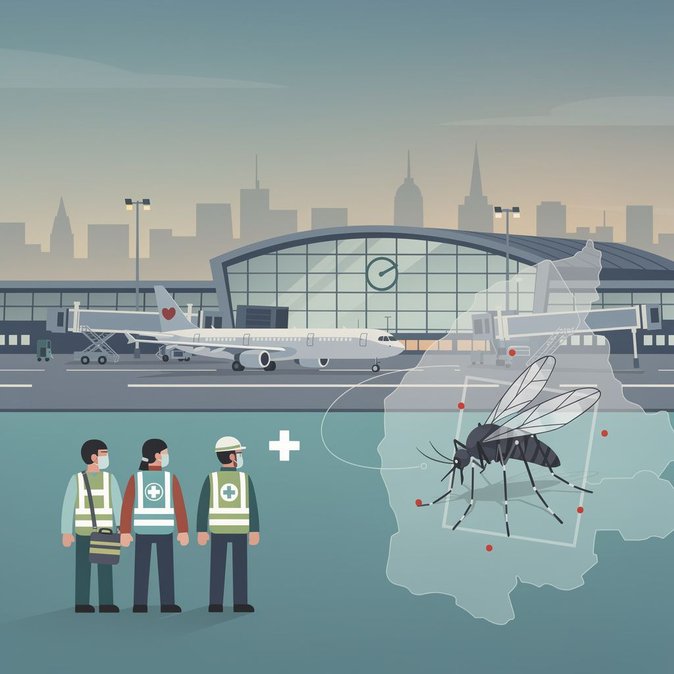
Public-health officials in Frankfurt confirmed in the early hours of 7 October that investigations are still under way into eight malaria infections—three of them fatal—recorded since the summer among airport workers and nearby residents. The city’s health department told dpa, and the regional broadcaster ntv reported, that six of the patients were employed at Frankfurt Airport while two lived in the adjacent district of Schwanheim. The working hypothesis is “Flughafen-Malaria”, a rare phenomenon in which Anopheles mosquitoes hitchhike on flights from endemic regions, survive the cabin or cargo hold, and bite ground staff or locals before dying in Germany’s cooler climate. Entomologists have deployed specialised traps both airside and in Schwanheim, but no live Anopheles specimens have been caught so far. With autumn temperatures falling, officials expect the risk to subside naturally, yet they urge anyone with fever after airport duty or international travel to seek testing. For global-mobility managers the cluster is a reminder that business-travel risk assessments must look beyond headline destinations. Staff who spend prolonged periods on airport aprons—or who live under flight paths—can face health exposures usually associated with the tropics. Companies are reviewing pre-trip briefings, advising repellent use during ramp work and checking insurance coverage for vector-borne diseases even on European assignments. While no travel restrictions have been imposed, the incident may accelerate calls for tighter aircraft disinsection protocols on flights arriving from sub-Saharan Africa and parts of Asia. Germany’s aviation regulator and the European Centre for Disease Prevention and Control are said to be monitoring the case file closely.
Source: ntv/dpa regional wire