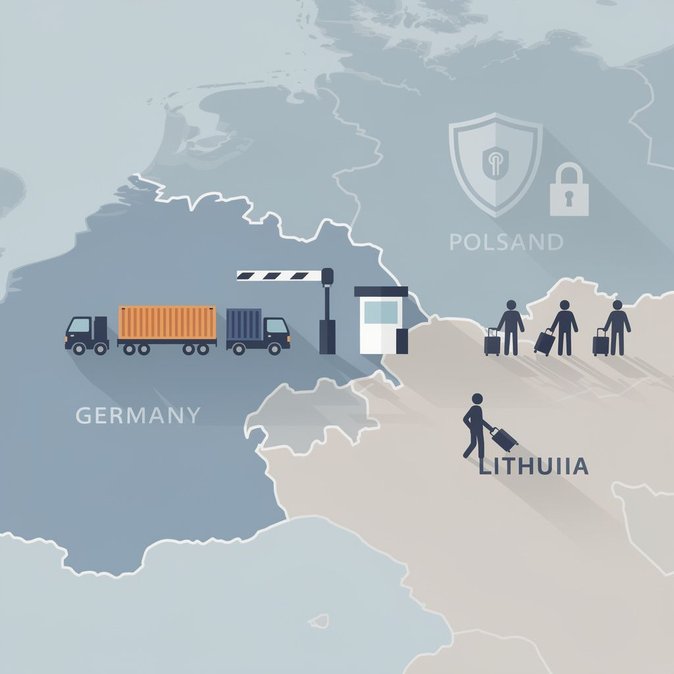
Germany has formally notified the European Commission that it will prolong temporary controls on its land borders with Poland and Lithuania for another six months, taking the current regime through to 31 March 2027. The Interior Ministry argues the measure is still needed to deter irregular migration, combat people-smuggling networks and curb cross-border crime. German officers have been carrying out random passport inspections on the Polish frontier since October 2023 and on all nine land borders since September 2024; Warsaw introduced its own checks in July 2025. Although the checks are selective rather than systematic, they have already lengthened vehicle queues at major crossings such as Świecko–Frankfurt(Oder) and Kudowa-Słone–Nacher, with wait times for trucks occasionally topping two hours. Logistics associations say longer and less predictable transit times are increasing costs for time-critical supply chains serving Germany’s automotive and electronics clusters in Brandenburg and Saxony. For business travellers, the practical impact is limited to potential delays and the need to carry proper identification even on normally passport-free journeys. Corporate mobility managers are nevertheless advising employees to schedule extra time when routing via Poland, to keep electronic copies of assignment letters handy, and to verify residency card validity if staff are third-country nationals. Politically, the extension underscores Berlin’s hardening line on border security amid public concerns over migration and recent regional election gains for the far-right AfD. It also places additional pressure on the EU to finalise its long-stalled overhaul of the Schengen Borders Code, which would tighten the criteria and time limits for such internal checks. Looking ahead, the Interior Ministry says it will review the necessity of controls again in February 2027. Companies that rely on just-in-time road haulage between Poland, the Baltic ports and eastern Germany should monitor the review closely and factor potential disruptions into their contingency planning.