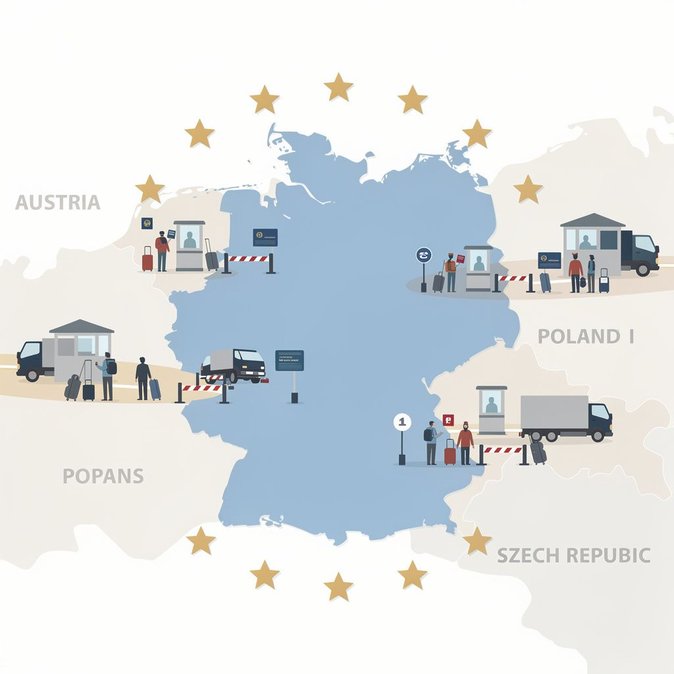
Germany’s Federal Interior Minister Alexander Dobrindt (CSU) has formally notified the European Commission that the temporary checks at all German land borders will be prolonged for another six-month period, pushing the expiry date to mid-March 2027. The measure, first introduced on 16 September 2024 and already renewed three times, was justified by the ministry with reference to continued pressure on the EU’s external frontiers and a spike in irregular migration over the summer. Under the Schengen Borders Code, member states may re-introduce controls only in “exceptional circumstances” and for strictly limited periods. Berlin’s repeated extensions have therefore drawn sharp criticism from Brussels. EU Migration Commissioner Magnus Brunner reiterated on 12 October that the measure undermines the principle of free movement within the Schengen Area and urged Germany to return to normality as soon as possible. For business travellers, expatriates and cross-border commuters the decision mainly translates into longer journey times and the need to carry passports or national ID cards at all times. Non-EU nationals living in Germany should also have their residence cards (Aufenthaltstitel) ready for on-the-spot inspections. Spot checks are most frequent on the A4 (Görlitz–Poland), A12 (Frankfurt/Oder–Poland), A8 (Salzburg–Austria) and on regional rail services crossing the Austrian and Czech borders. Logistics operators warn that the extension could add unforeseen delays and costs to just-in-time supply chains between Germany and neighbouring markets. The German Chambers of Commerce and Industry (DIHK) are urging the government to liaise closely with customs and police so that accredited trusted-trader programmes (AEO, CTP) can continue to use fast-track lanes. While the border controls do not affect visa or residence regulations inside Germany, they highlight a growing tension between national security concerns and the EU’s pledge to keep internal borders open. Companies with frequent cross-border staff movements are advised to brief travellers, build in extra buffer time and monitor further political developments as the next review deadline in March 2027 approaches.
Source: The New German