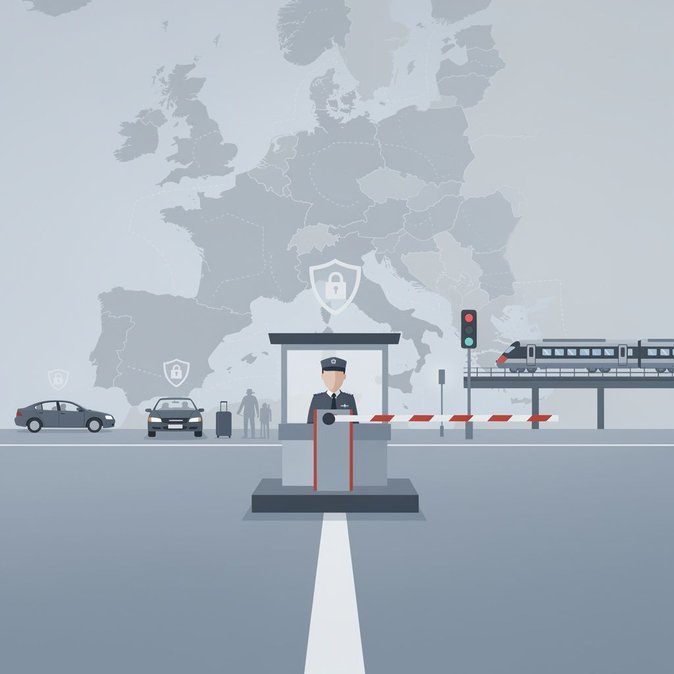
Germany’s Federal Ministry of the Interior has formally notified the European Commission that it will prolong systematic controls at all of Germany’s land borders for another six-month period, running from 16 September 2026 to 15 March 2027. Interior Minister Alexander Dobrindt (CSU) justified the move by pointing to continuing irregular migration pressures on Europe’s external frontiers, migrant-smuggling networks operating along the Balkan and Central Mediterranean routes, and elevated security concerns arising from Russia’s war on Ukraine and instability in the Middle East and Central Asia. The re-imposition of controls at Germany’s borders with Austria in 2024 was originally presented as a short-term emergency step. Since then, the measure has been rolled over three times and gradually widened to cover Germany’s entire land frontier, including crossings with Poland, Czechia, Switzerland, France, Luxembourg, Belgium, the Netherlands and Denmark. Under the Schengen Borders Code, such internal checks must remain a “last-resort” and “temporary” response to a specific threat, and every extension requires detailed justification to Brussels. Criticism has mounted in Brussels and in neighbouring capitals. EU Migration Commissioner Magnus Brunner warned this summer that the repeated renewals undermine Schengen’s principle of free movement and risk a domino effect as other member states follow suit. Civil-society groups in Germany argue that the bulk of irregular entries now occur through asylum seekers who present themselves at official crossings anyway, making blanket checks disproportionate. For business travellers and cross-border commuters the practical impact is felt in longer queues and spot checks on vehicles and trains. Non-EU nationals are advised to carry passports and residence permits at all times, as officers may request proof of legal status during inland patrols within the 30-kilometre border zone. While visa rules and the right to move within Germany remain unchanged, companies should factor potential delays into logistics plans and employee travel policies—particularly for shuttle services that cross into neighbouring countries several times a day. Germany’s notification triggers a review by the European Commission, which could issue an opinion questioning proportionality but cannot unilaterally block the extension. Unless the federal government changes course, systematic land-border checks will now be in place for at least two and a half years—an unprecedented stretch in Schengen history and a bell-wether for how Europe balances mobility with security in an era of overlapping crises.
Source: The New German