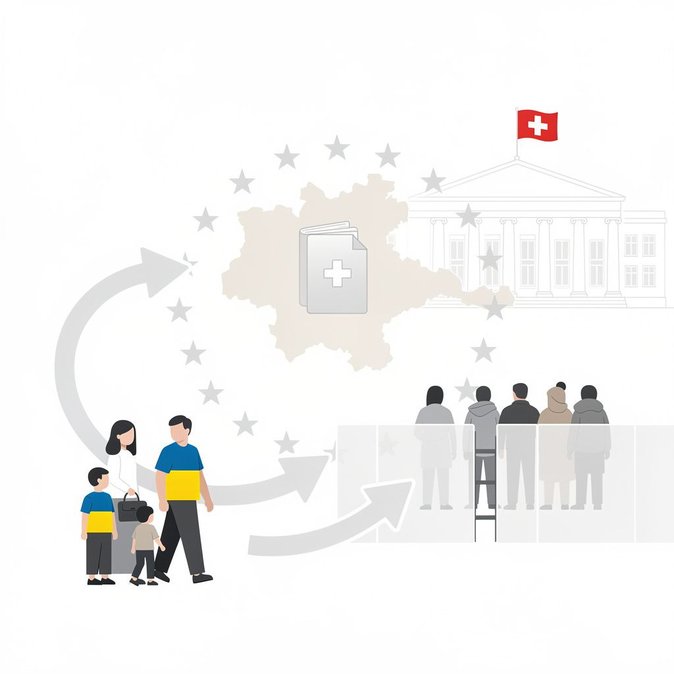
The Swiss Federal Council has asked Parliament to enshrine in law the temporary travel privileges enjoyed by people who hold Switzerland’s Status S protection. Introduced in March 2022 for those fleeing Russia’s invasion of Ukraine, Status S gives beneficiaries immediate residence, the right to work, and—crucially—the possibility to travel abroad and re-enter Switzerland without first applying for a permit. At its meeting on 11 November 2026, the cabinet adopted a draft amendment to the Federal Act on Foreign Nationals and Integration that would maintain those privileges until Status S is lifted. The proposal mirrors the EU rule that lets Ukrainians with biometric passports spend up to 90 days in the Schengen area visa-free. Trips back to Ukraine would remain limited to 15 days per half-year, a safeguard Bern says is needed to ensure the protection remains temporary. The bill simultaneously tightens the rules for two other groups: asylum seekers whose cases are still pending and migrants admitted on a provisional basis (Status F). For them, foreign travel would become an exception requiring explicit authorisation. The government argues that clear differentiation is essential to prevent misuse of asylum processes while aligning with European practice for war-displaced persons. If Parliament approves, companies and universities will have greater certainty when their Ukrainian employees or students need to attend conferences, visit relatives, or take business trips elsewhere in Europe. HR teams should nevertheless remind staff that the change is not yet in force and that the 15-day cap on stays in Ukraine still applies. With Status S now extended until at least March 2028, the travel clause is a practical test of how Switzerland balances solidarity with Ukraine against the integrity of its wider migration system.