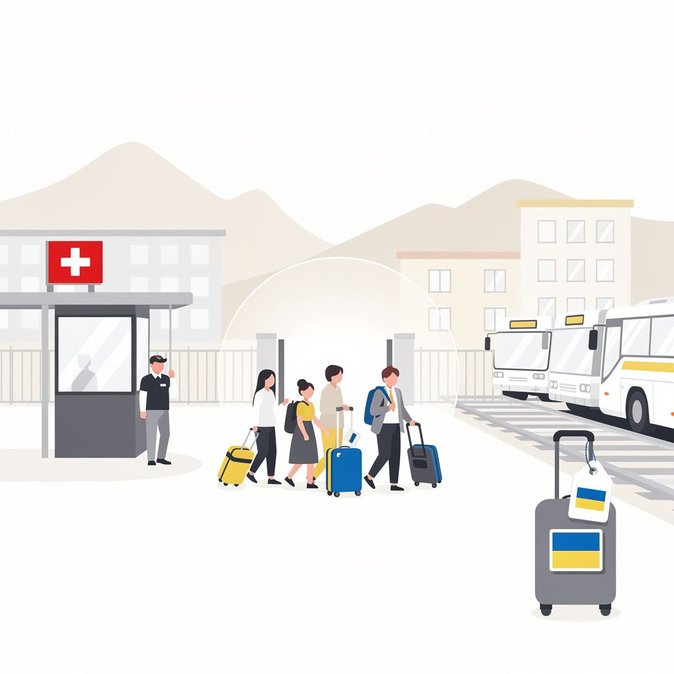
The Swiss Federal Council has formally confirmed that Ukrainians living in Switzerland under the special S-protection status will retain their right to travel abroad without additional authorisation. In a message submitted to Parliament on 11 November 2026, the government explained that broader travel restrictions it intends to introduce for other categories of asylum seekers and temporarily-admitted foreigners will explicitly not apply to S-status holders. The S-protection status was activated in March 2022, only weeks after Russia’s full-scale invasion of Ukraine, and currently covers about 66 000 people. It gives beneficiaries the right to live, work and study in Switzerland and – crucially for both personal and professional mobility – allows them to leave and re-enter the country without advance permission. Other foreigners with provisional admission generally require authorisation from the State Secretariat for Migration (SEM) for any travel outside Switzerland and are barred from visiting their country of origin. According to the explanatory report, Parliament had already asked the Federal Council in 2021 to tighten travel rules for provisionally admitted persons in order to prevent abuse of the asylum system. Implementation was postponed once S-status was activated, because the rapid influx from Ukraine required legal clarity. Wednesday’s decision preserves the exceptional freedom of movement for Ukrainians while aligning rules for all other categories. The government emphasised that maintaining mobility helps displaced Ukrainians keep family ties, pursue cross-border business or academic activities, and prepare for eventual reconstruction efforts at home. For employers and universities, the clarification removes lingering uncertainty about business trips, conferences or field research involving Ukrainian staff and students. Humanitarian organisations also welcomed the move, noting that many beneficiaries travel to neighbouring EU states for administrative matters or to visit relatives who have spread across Europe. The Council underscored that the exemption will remain in force as long as S-status itself is maintained – currently until at least March 2028 – but could be revisited should conditions in Ukraine allow for large-scale returns.
Source: SWI swissinfo.ch